The short version
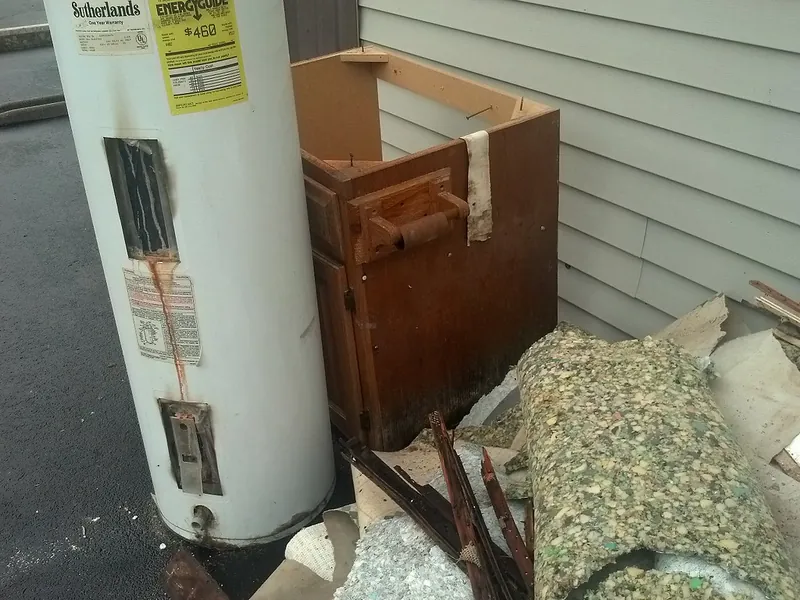
A water heater leak in Acampo starts with the cold inlet valve, then the power or gas, then photos of the tank and wet surfaces. Plumbers handle the tank while a restoration provider dries the rooms. The EPA puts the drying window at 24 to 48 hours.
What is the first thing to do about a water heater leak in Acampo?
Stop the water feeding the tank, then kill its heat source. With a water heater leak in Acampo, the order matters because pooled water and live wiring are a bad mix. Keep off wet floors until the circuit is confirmed dead.
- Turn the cold water inlet valve clockwise. If the handle is stuck, shut the main valve for the whole house instead.
- For an electric unit, flip its breaker off. Do this only when the panel is dry and you never have to wade to reach it.
- For a gas unit, turn the gas control to off. A gas odor means you step outside first and phone 911 or the utility from there.
- Photograph the tank, its rating label and every wet surface before anything is moved.
- Call a plumber to find the cause and repair or replace the unit.
- Ask for a restoration provider to pull out the water and dry the rooms it reached.
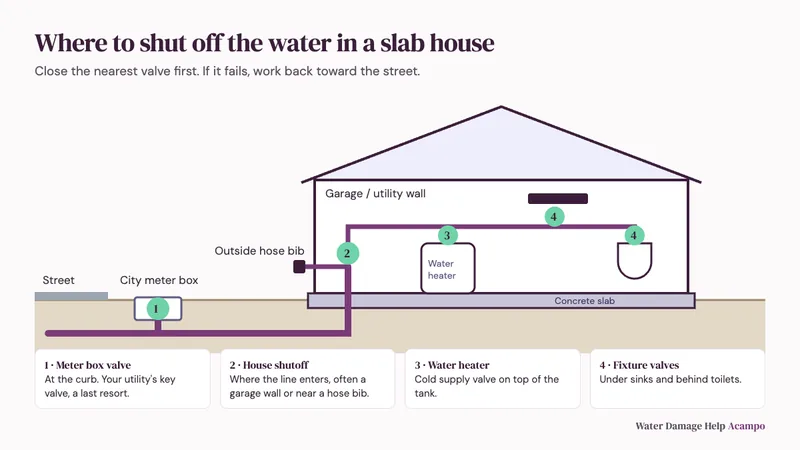
Once the tank has stopped feeding the leak, the next job is removing what already spilled. The page on water removal in Acampo explains how standing water is pulled out. If the water went into a ceiling, read about ceiling water damage repair before touching the drywall.
Where is the water heater leaking from?
The wet spot points to the cause. A leak at a fitting is a cheap fix, while a leak through the tank shell means the tank is finished. The table pairs each symptom with a probable cause, a safe check and the trade that handles the fix.
| What you see | Likely cause | Safe check | Who to call |
|---|---|---|---|
| Drips on top of the tank | A loose or worn pipe connection | Close the inlet valve and watch whether the dripping stops | Plumber |
| Water pooling around the base | A corroded tank wall or a failed tank | Rust streaks or a steady trickle coming off the shell | Plumber, often for a replacement |
| Drip from the pipe beside the tank | The temperature and pressure relief valve opening or wearing out | Note whether it drips while the heater is heating | Plumber |
| Water at the small valve near the bottom | A worn drain valve | Confirm the handle is fully closed | Plumber |
| Wet floor but a dry tank | Water from a nearby pipe, appliance or air handler | Follow the wet trail back to its lowest and highest points | Plumber or AC technician |
Ask the plumber to name the cause in plain words. If the shell has failed, repair is rarely an option, and you want to hear that before paying for a patch. Other sources are covered on the appliance leak page.
Does California require water heaters to be braced?
Yes. Health and Safety Code section 19211 covers new, replacement and existing residential heaters. Each must be braced, anchored or strapped so shaking does not topple it. A tipped tank can snap its supply pipes and flood a room, so the strapping is part of the leak story, not a separate matter.
The same section says a seller of real property containing a water heater must certify in writing to the buyer that the bracing rule was followed. That certification can sit in the sales contract or in a transfer disclosure statement.
For a leak, the point is simple. When the plumber replaces the tank, ask how it will be strapped and whether the bracing meets code. A California Earthquake Authority sample policy also lists water released from a water heater as a result of an earthquake as a loss the policy does not exclude, though your own policy and deductible control what is paid.
If the heater was knocked loose by shaking, tell your insurer which kind of event caused the damage, since earthquake and ordinary plumbing claims are handled under different policies.
What if the heater is in a garage, a closet or an attic?
Where the tank sits decides where the water goes. A garage heater floods a hard floor and the bottom of shared walls. A closet heater soaks flooring and walls next to it. A heater above living space can drop water through a ceiling.
The records for Acampo do not say which type of house is common here, so check your own. Find the tank before an emergency and note whether there is anything below it that water could ruin.
- Garage: lift stored boxes off the wet floor and wear shoes. Drywall at the base of the wall wicks water upward fast.
- Closet: pull up wet flooring edges only after the power is off, because water travels under floor coverings.
- Attic or upper floor: expect the stain to show away from the tank, since water follows framing. Do not stand under a bulging ceiling.
For wood, laminate or tile that has been wetted, see water-damaged floor repair. If a ceiling is sagging, the ceiling page shows how to relieve it safely.
Can a drain pan or leak sensor stop the damage?
A pan catches drips and a sensor tells you about them. Neither one holds a whole tank that splits open. They are early warnings for slow leaks, and they only work when the pan drain is open and the sensor battery is alive.
- Look into the pan now and then for water, rust flakes or mineral scale.
- Make sure the pan's drain line is open and ends where water will do no harm.
- Keep cardboard and paper out of the pan and off the floor near the tank.
- Put a battery sensor on the floor beside the heater so your phone or an alarm warns you.
An automatic shutoff valve is a heavier option that closes the supply when it detects water. A plumber can say whether one suits your setup. The prevention guide compares these devices with other fixes.
Is it normal for the relief valve to drip?
A temperature and pressure relief valve is a safety part. It opens when pressure or heat climbs too high, and it should send water down a discharge pipe. An occasional release can be normal. A steady drip is a sign something is wrong.
A constantly weeping valve may mean the valve is worn, the water pressure is high, or the heater is running too hot. Never cap or plug the discharge pipe. Blocking it disables the safety feature.
- Keep children and pets away from the discharge, since the water can be scalding.
- Write down when the drip happens, such as when the burner or element starts.
- Ask a plumber to test the valve and measure the house water pressure.
If the discharge has soaked a wall or floor, treat it like any other leak and start drying. Water mitigation describes what the first stage of a drying job covers.
Does homeowners insurance cover a water heater leak in California?
Often it covers the water damage but not the heater. The California Department of Insurance explains that a homeowners policy leaves out flood yet does pay for other water damage. Triple-I adds that standard forms list accidental discharge from plumbing, heating systems and household appliances.
Triple-I also says policies do not pay for damage from lack of maintenance. A rusted tank that failed slowly can draw questions about whether the leak was sudden or gradual. Read the policy wording and ask the insurer how it treats your cause.
Expect the new tank to be your expense. A claim is more likely to reach the soaked drywall, flooring and insulation. Hold on to photos of the label and the failure until an adjuster has visited.
Step-by-step claim handling sits in the water damage insurance claims guide. If your home is on the California FAIR Plan, note that the CDI describes it as a bare-bones fire policy and says water damage is among the perils needing extra coverage.
How long does a California insurer have to answer a heater claim?
Notice of a claim starts a 15 calendar day clock for the insurer to acknowledge it, under California Code of Regulations, Title 10, section 2695.5(e). After it has proof of claim, it has 40 calendar days to accept or deny, under section 2695.7(b).
If more time is needed, the insurer must say so in writing within the 40 days and then every 30 calendar days. A denial must be in writing, list its reasons and tell you that the Department of Insurance can review it. The Department's consumer line is 1-800-927-4357.
- Report the leak to your agent or company right away.
- Limit further damage with reasonable steps, and wait for the adjuster before any lasting repair.
- Save receipts for the plumber, the new tank and the drying.
- Collect written bids that itemize materials and prices, which is Triple-I's advice.
Triple-I also notes that a public adjuster can cost as much as 15 percent of the settlement, so ask about the fee before signing.
How is the water damage dried after a heater leak?
Drying follows a fixed order: stop the source, extract, remove what cannot be saved, dry with fans and dehumidifiers, then check readings. IICRC S500 treats supply-line and tank water as Category 1, clean water, though time and dirty surfaces can lower that.
- Stop the source and extract standing water.
- Remove wet material that will not dry, such as soaked insulation or swollen drywall.
- Dry the structure with air movers and dehumidifiers.
- Log moisture readings on every visit to show progress.
- Rebuild after the materials read dry.
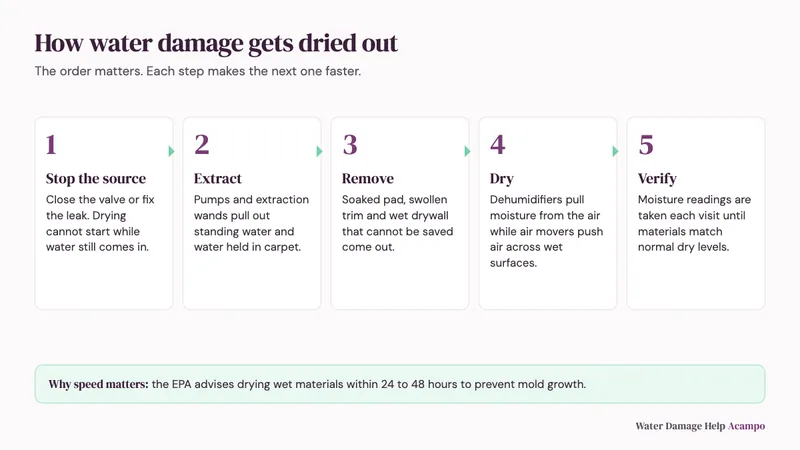
Mold prevention sets the pace. The EPA's guidance is to dry wet areas and belongings in 24 to 48 hours, and the CDC recommends removing soaked carpet and upholstery that cannot dry fast. Equipment is covered under structural drying, and an area that stayed damp is the subject of mold after water damage. Each provider offers different services, so confirm the scope when you are connected.
Who can legally replace a water heater in California?
A licensed plumbing contractor is the safe choice. The Contractors State License Board says a person may work without a license only on small projects up to $1,000, and only if no workers are hired and no building permits are needed. That $1,000 covers labor and materials.
Because labor and materials count toward that limit, ask any installer for a license number and check it with the board. CSLB also cautions that a deposit above 10 percent of the contract price is too much, and that payments should track finished work.
The board lists penalties for unlicensed contracting that include fines of up to $15,000. Read about choosing a restoration company for questions to ask any provider, including what a quote covers.
How can I keep my water heater from leaking?
Inspect the heater on a routine and swap an aging one before it fails. Rust, a damp base and a weeping relief valve are the warning signs. A clear area around the tank makes small leaks easy to see, and a quick look each month costs nothing.
- Learn where the cold inlet valve is and confirm it turns.
- Check the tank, pipes and pan each time you pass the heater.
- Have a plumber advise on flushing the tank and testing its relief valve.
- Make sure the earthquake straps are tight and the tank does not rock.
- Add a floor sensor or an automatic shutoff valve where the heater sits over living space.
- Plan the replacement of an aging tank instead of waiting for it to burst.
Hidden leaks show themselves early if you know the clues, and the signs of water damage guide lists them. A split pipe is a different problem, covered under burst pipe water damage. For your area, the San Joaquin County page lists nearby communities, and the statewide site covers the rest of California.
Sources: Cal. Code Regs. tit. 10, 2695.5; tit. 10, 2695.7; CDI, Residential Property Claims Guide; Health and Safety Code 19211 (Seismic Safety Commission); California Earthquake Authority sample policy; CSLB press release 24-21; Triple-I, Which disasters are covered; Triple-I, Settling claims; CDI statement on the FAIR Plan; IICRC S500; EPA; CDC.