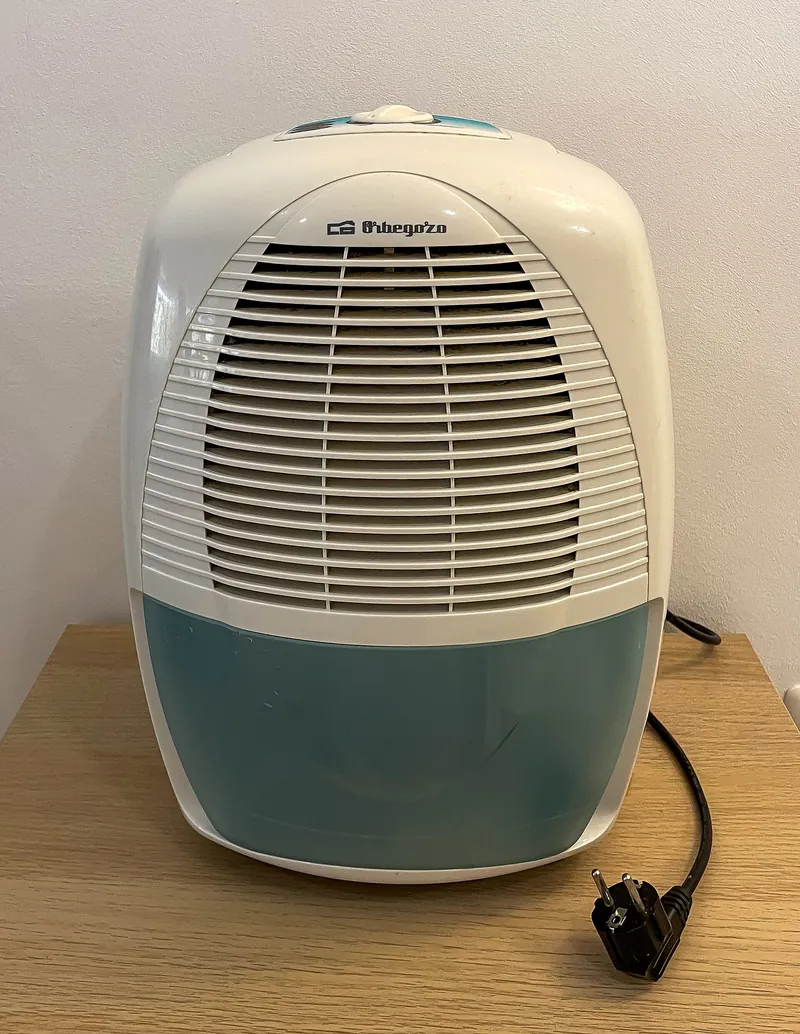
The short version
For wet carpet drying in Acampo, stop the water, pull up what is standing and start fans and a dehumidifier. Carpet from a clean leak can often be saved, the pad often cannot after grey water, and flood water or sewage means both are removed. The EPA says to dry in 24 to 48 hours.
How do I dry wet carpet right away?
Remove the water source, soak up as much standing water as you can and get air moving. Carpet fibers dry quickly on top, but the pad and the floor beneath hold moisture for much longer, so the first day matters more than any later step.
- Stop the leak at the valve or have a plumber repair it. Drying cannot begin while water is still coming in.
- Switch off power in the wet room at the breaker if the panel is dry to reach.
- Photograph the carpet and the source of the water before you move anything.
- Lift furniture off the carpet and put foil or plastic blocks under the legs.
- Blot and vacuum standing water with a wet-dry vacuum, then open windows and run fans and a dehumidifier.
- Phone your insurer and ask for a local water damage restoration team that extracts water from carpet.
The EPA's mold guide advises drying wet areas within 24 to 48 hours to keep mold from starting. For shutoff steps after a pipe failure, see the burst pipe page.
Can wet carpet be saved?
Often, if the water was clean and the carpet is dried promptly. Carpet that took only a light soaking from a supply line or a small spill usually survives. Dirty water or a long soaking shifts the answer toward replacement, mostly because of what is underneath the surface.
| Where the water came from | The carpet | The pad underneath | Usual direction |
|---|---|---|---|
| Supply line, burst pipe, roof leak | Often cleaned and dried in place | Frequently dried or replaced | Extract and dry quickly |
| Washer, dishwasher or AC drain overflow | Can sometimes be saved if caught early | Usually replaced | Pad out, carpet cleaned and dried |
| Toilet overflow with waste | Treated as contaminated | Replaced | Both usually removed |
| Sewage or flood water | Removed and thrown out | Removed and thrown out | Remove, clean the floor, dry it |
Water category matters. The IICRC S500 sorts water into three groups from clean to grossly contaminated, and carpet in the dirtiest group is not kept. See the sewage backup page for what that involves.
Should the carpet pad be kept or thrown out?
The pad is the part most often replaced. It acts like a sponge, holds water long after the carpet looks dry and dries slowly. Pad that took anything other than clean water, or that stayed wet for a long time, is generally discarded.
A pad hit by a clean leak and treated right away can sometimes be dried. Many providers lift the carpet from the tack strip, pull the pad and put the carpet back over the dry floor.
Replacing a pad costs far less than a failed pad. A soggy pad grows mold underneath carpet you cannot see, and the smell often shows up weeks later. Ask the provider what they will check before deciding, and whether the pad is part of the quote or priced separately.
Is a shop vac enough to pull water out of carpet?
A wet-dry vacuum handles puddles and light wetting, but it will not pull deep water out of thick carpet and the pad beneath it. It is a useful first step on the first day. It does not replace professional extraction when a whole room is soaked.
Work slowly in overlapping passes and empty the tank often. Do not use a household vacuum, which is not made for water and can cause a shock. Keep the cord away from wet areas, and stop if the outlet or cord is wet.
After the vacuum, moisture remains in the fibers, the pad and the floor. Providers use truck-mounted or portable extractors, then add air movers and dehumidifiers, and a rented machine should be followed the same way. See water removal for how extraction works, and renting a dehumidifier vs hiring a pro for the trade-offs.
What is the best way to dry carpet after a leak?
Combine extraction, airflow and dehumidification, then confirm the result with readings. Fans alone only move moist air around the room. A dehumidifier pulls the water out of that air, so the carpet and pad can keep releasing what they hold.
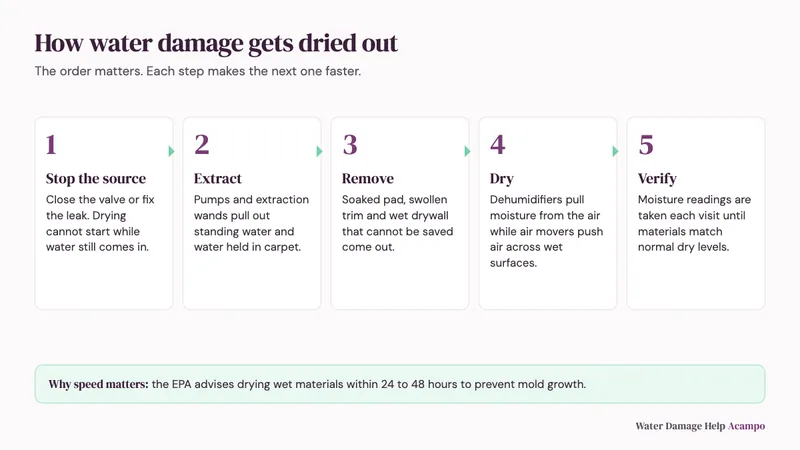
Lifting a corner of the carpet and propping it over a fan lets air reach the pad and floor beneath. Some providers detach carpet along one wall for this. Keep doors closed on a room with a dehumidifier so it works on the damp air and not the whole house.
Track room humidity. The EPA's mold guidance says to stay under 60 percent relative humidity, ideally 30 to 50 percent, and notes that a humidity meter costs $10 to $50. Use fans and a dehumidifier together, and avoid heaters that blast the carpet.
Do I need to check the tack strip and the floor below?
Both need to be checked, because wet carpet is rarely a carpet-only problem. Tack strip is wood and can rot or stain, and the subfloor can swell or grow mold. Checking them is part of any proper drying job, and it is easy to skip.
If the carpet is lifted, look at the tack strip for dark staining and at the floor for soft spots. Plywood and particleboard subfloors lose strength after long soaking.
Providers measure moisture in the floor before re-laying carpet. Ask them to read the subfloor, not just the carpet, and to tell you the numbers they get. See water-damaged floor repair for how different floors dry.
Why does wet carpet smell, and will it go away?
The musty smell comes from microbes and mold growing in damp fibers and pad. It fades once the carpet and pad are truly dry and clean. If the smell comes back, moisture is still hiding somewhere in the layers below the surface.
A lingering odor after drying usually means contaminated water, wet pad or damp subfloor. Air fresheners and baking soda cover it without fixing it. The right fix is to find the wet layer and remove or dry it.
Carpet that smells after dirty water often has to go, and so does the pad under it. For a longer guide to musty odors, see water damage smell.
How fast can mold start in damp carpet?
Faster than most people expect. The EPA's target for drying wet items is 24 to 48 hours, and it ties that target to preventing mold. Carpet and pad stay wet longer than hard surfaces, so they are among the first materials to go moldy.
Signs of trouble include dark spots on the carpet backing, a musty smell and rising allergy symptoms. The CDC says mold can cause nasal stuffiness, wheezing, burning eyes and skin rash, and that people with asthma or mold allergy can react more strongly.
The CDC also says to remove soaked carpet that cannot be dried right away after a flood. If mold is already present, see mold after water damage, and allergies after water damage for the health side.
What happens to carpet after flood water or sewage?
It comes out, along with the pad. Flood water and sewage are Category 3 in the IICRC scheme, meaning grossly contaminated, and carpet in that category is generally thrown away. The EPA says to call a professional with experience in buildings damaged by contaminated water.
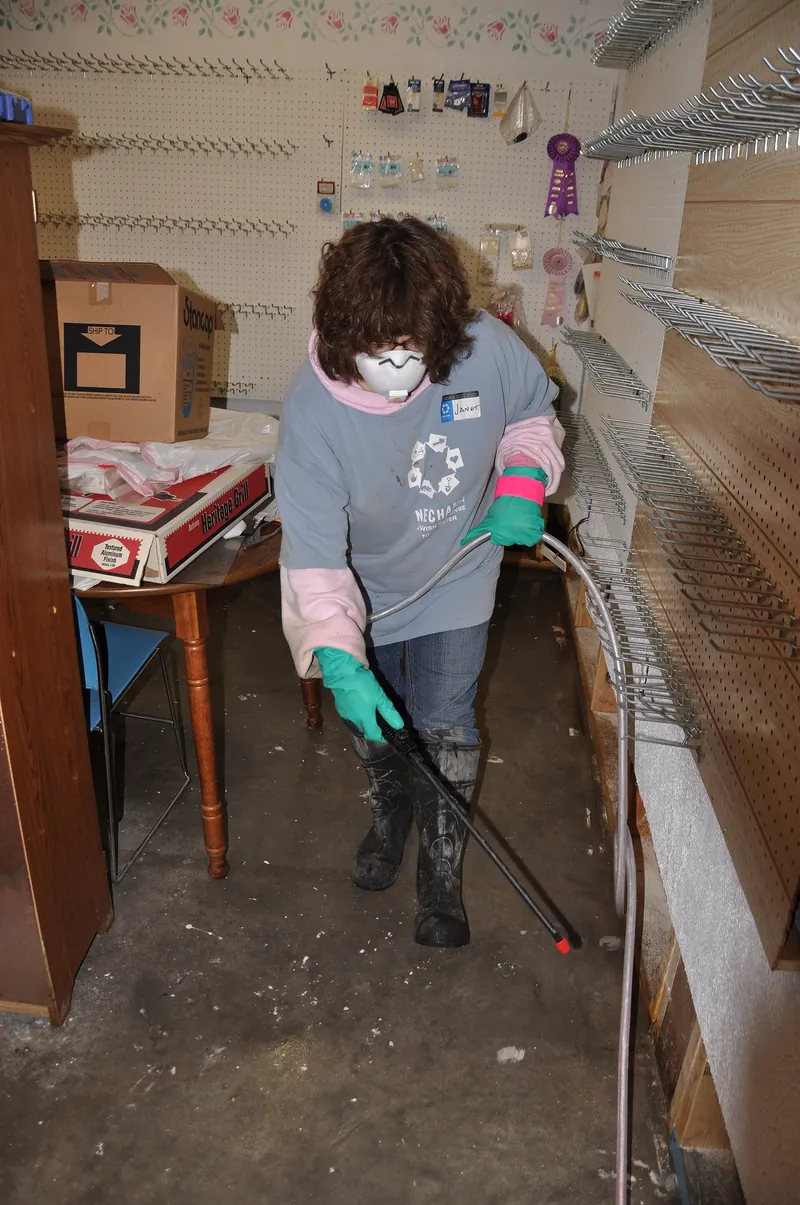

Protect yourself while you wait. Ready.gov advises heavy gloves, boots and protective clothing, and keeping children out of cleanup. People with asthma or weak immune systems should stay away from the affected area.
Winter storms and atmospheric rivers cause most flood events in California, and the Mokelumne River corridor near Lodi is part of that picture. See flood cleanup and atmospheric river prep.
How long should I expect carpet drying to take?
It depends on how much water, what kind of carpet and pad, and the airflow in the room. No single number fits every job. What matters is reaching dry readings in the first 24 to 48 hours the EPA recommends, and confirming them with a meter.
Thick carpet over a dense pad takes longer than thin carpet. Cool, damp air slows drying, and Lodi-area winters are cool and wet with dense ground fog. In winter a dehumidifier does more of the work than open windows, while hot, dry summer air dries faster but can mislead you about the pad.
Ask the provider how they will decide the carpet is done. A good answer mentions readings compared with a dry reference, not just touch, and a plan to return if the numbers have not dropped.
What if the carpet is glued down or laid over concrete?
Glued-down carpet is harder to dry because it cannot be lifted, and it often has to be removed. Carpet over a concrete slab is a separate case: concrete holds moisture and releases it slowly, so the floor itself needs checking.
Whether your house has a slab is not something this site can tell you, since housing type is not documented for Acampo. If your carpet sits directly on concrete, ask the provider to test the slab, because moisture can wick up and cause smells after the carpet looks dry.
Direct-glue carpet also leaves adhesive behind. Removal and cleanup can add steps. If a chemical odor or old adhesive is present, tell the provider before work starts, since it can affect how the room is aired and cleaned.
What does carpet water damage repair cost?
Fixr's national guide lists carpet restoration at $4.75 to $10.50 per square foot. Its extraction ranges depend on the water type: $3.75 to $4.25 clean, $4.10 to $6.50 grey and $7 to $7.50 black. These are national averages, not quotes.
Prices rise with the water category, the room size and the pad work. Providers set their own rates and differ, so ask for a written estimate that separates extraction, drying and replacement. A line-by-line estimate also helps if you file a claim.
In California, CSLB advises that a down payment not exceed 10 percent of the contract price. See water damage restoration cost for how costs break down.
Will insurance pay for wet carpet in California?
Often, when the water came from a covered event such as a burst pipe or an appliance failure. As the state insurance department puts it, flood is excluded from homeowners policies while other water damage is covered. Check your own policy.
Triple-I notes that sewer backups are generally not covered by a typical policy or by flood insurance, and need a separate endorsement. Take photos, save receipts and keep damaged carpet until the adjuster has looked, as Triple-I advises.
Under 10 CCR 2695.5 and 2695.7, the insurer has 15 calendar days to acknowledge the claim and 40 more from proof of claim to decide it. Questions can go to CDI at 1-800-927-4357. See water damage insurance claims.
Sources: EPA mold and moisture guide; EPA mold cleanup page; IICRC water categories; CDC mold and health page; Ready.gov flood safety; Fixr cost guide; CSLB contract guide; CDI claims guide; Title 10 CCR sections 2695.5 and 2695.7; Triple-I coverage article; Triple-I claims article; Wikipedia, Lodi.