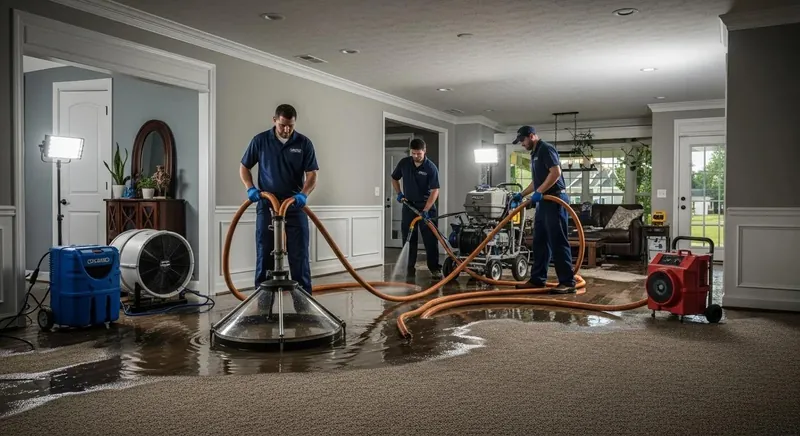
The short version
After an appliance leak in Acampo, close the supply valve or the main shutoff, trip the breaker if water is near outlets, and photograph everything. A plumber or technician fixes the unit while a restoration provider deals with the water. The EPA advises getting wet materials dry in 24 to 48 hours to head off mold.
What is the fastest way to stop a leaking appliance?
Turn the valve that feeds it. Every washer, dishwasher, toilet and ice maker has one, usually within arm's reach. If it will not move, go to the main shutoff for the house, because stopping the supply comes before cleaning or calling anyone.
- Close the supply valve at the appliance, or the main valve if that fails.
- Check for electrical risk. If water touches outlets or cords, trip the breaker, but only from a dry stance.
- Shoot photos and a short video of the machine, the wet path and each damaged surface before moving things.
- Clear the floor of rugs, boxes and shoes, then blot pooled water.
- Make two calls: a plumber or repair technician for the unit, and a restoration provider for the water.
Pulling water out and drying the structure is restoration work. The water removal page outlines it, and each provider should confirm directly what it handles and when.
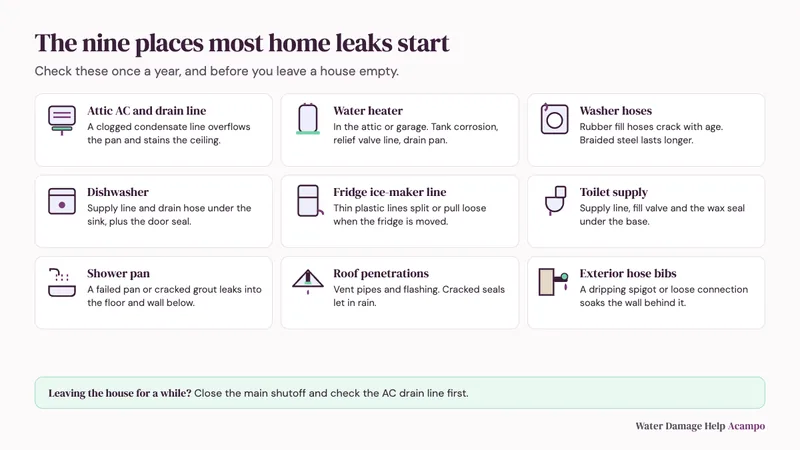
Does the kind of appliance change the water category?
Yes. IICRC S500 sorts water by contamination, and the source sets the class. Supply line water is Category 1, clean water, while water that has passed through a washer or dishwasher is Category 2, grey water, and the class shapes what can be dried.
| Appliance | Weak spots | Shutoff | IICRC S500 class |
|---|---|---|---|
| Tank water heater | Shell, drain valve, pipe unions, relief valve outlet | Cold inlet valve on the unit, plus the gas valve or breaker | Category 1 if it is supply water |
| Washing machine | Fill hoses, drain hose, pump, overfull standpipe | Pair of valves in the wall box | Category 1 from fill hoses, Category 2 from drain water |
| Dishwasher | Door gasket, supply and drain hoses | Valve in the sink cabinet | Category 1 from supply, Category 2 from drain water |
| Fridge with ice maker | Narrow water tube and its fittings | Valve on the tube or at a nearby sink | Category 1 from supply |
| Water softener | Connections, drain line, brine tank | Bypass valve or the main shutoff | Provider assesses on site |
| Toilet | Supply line, fill valve, tank, wax seal | Wall valve behind the bowl | Category 1 from supply, Category 2 if the bowl overflowed clean |
Water that picks up waste moves to Category 3, which is what sewage backup cleanup deals with.
How urgent is a leaking water heater?
That depends on where it leaks. A gush from the tank shell is an emergency and a dripping fitting needs a plumber soon, while water at the relief valve pipe calls for a look at pressure and temperature. Heaters in garages and closets can leak a long while unseen.
- Shell leak: the tank is finished. Close the cold inlet, then switch off the fuel: gas control to off, or the breaker for an electric unit.
- Fitting or drain valve: shut the cold inlet and call a plumber, who can often replace the part and keep the tank.
- Relief valve discharge: leave the valve alone. Capping it removes a safety release.
Do not leave a heater energized once its water is off. The water heater leak page has more on pans and relief valves.
Why do washer hoses burst, and what happens to the floor?
Rubber fill hoses age, harden and eventually split, and a split hose discharges until someone closes the wall valves. The drain hose, the pump and a clogged standpipe are the other usual failure points. Of all appliance leaks, a burst fill hose often does the most damage.
Shutting both valves whenever the house is empty takes that scenario off the table. Spilled drain water counts as Category 2.
It spreads under the machine and along baseboards, and on an upper floor it can show up on the ceiling below. Do not drag a full washer through the wet. Set its feet on dry blocks if you can.
Can a slow dishwasher leak ruin the floor under the cabinets?
It can, and quietly. Water drops to the lowest point, so it gathers under the unit and soaks the cabinet base and subfloor before any puddle appears. A pinhole drip can continue for weeks, which is why the damage is often worse than the leak looks.
Suspects include the door gasket, the supply line and the drain hose beneath the sink. Pull the kick plate and look for dark stains, spongy wood or a cabinet floor that has swollen.
Nothing under a cabinet dries from the top down. A provider can read the moisture in cabinet bases and the subfloor and say what will dry where it sits. Repair the dishwasher first, or the cycle begins again.
What does a leaking fridge water line do behind the wall?
It works unseen. A thin tube feeds the ice maker and dispenser, and a loose fitting or pinhole can feed water into the wall, the next cabinet or the floor for weeks. Often the leak comes to light only when a plank lifts or a baseboard turns soft.
- Close the small valve on that line and stop using the ice maker.
- Slide the fridge out and examine the floor, the wall base and the tube.
- Look beside the fridge as well as in front of it.
Supply water starts out clean, but anything that sits in building materials can turn contaminated. The sooner drying starts, the less guesswork.
Where do softeners, toilets and AC drains fit in?
They fail like other appliances. A softener has connections, a drain line and a brine tank, a toilet has a supply line, fill valve and seal, and an air conditioner has a condensate drain that can back up. All of them can leak where nobody looks.
For a softener, move the bypass valve to bypass or close the main shutoff, and unplug it only if the floor at the outlet is dry. For a toilet, close the wall valve behind the bowl.
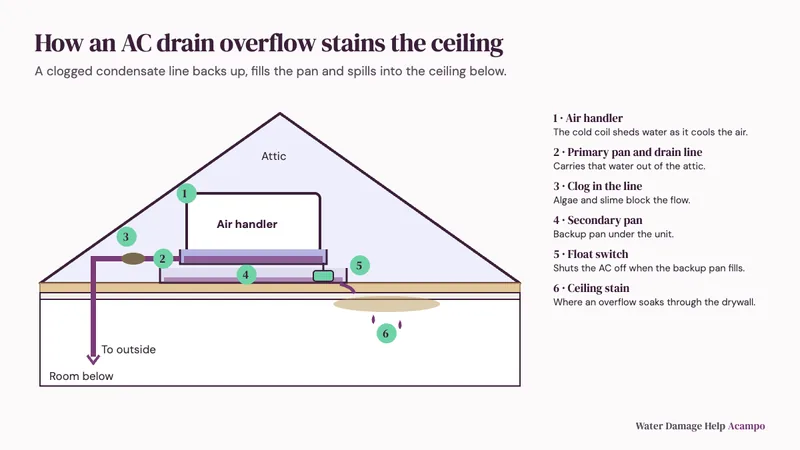
With an air conditioner, switch off at the thermostat so it stops making water. Pans and float switches are explained on the AC leak page, and a bulging ceiling is handled in draining a ceiling safely.
Which clues point to a hidden appliance leak?
The building often complains before the water shows. Watch for swollen cabinet bottoms, cupped or lifting floorboards, a musty smell that comes back, and soft or discolored patches near an appliance. Slow leaks behind a fridge or under a dishwasher hide until the materials start to change.
- Puffy cabinet bases under a sink or beside the dishwasher.
- Boards that cup or buckle near the kitchen or laundry.
- A stale odor that returns after cleaning.
- Blistered paint or baseboards pulling off the wall.
- A water bill that climbs without a change in how you live.
A moisture meter settles what the eye cannot. The EPA advises getting wet areas and belongings dry within 24 to 48 hours so mold does not take hold. See the signs of water damage guide, and the high water bill page if your bill has crept up.
Do leak sensors and auto shutoff valves pay off?
They shrink the damage when they are placed well and kept powered. A sensor on the floor next to the water heater, washer, dishwasher or fridge announces a leak while it is still a small one. Where they are not installed, they do nothing.
- Sensors rest on the floor where water would land. Some beep, and some message your phone.
- Automatic valves close the supply when a sensor trips. Ask a plumber what suits your piping.
- Batteries and Wi-Fi need periodic checks, because a dead unit protects nothing.
Neither device removes the need to look at hoses and fittings for bulges, rust and drips.
Is an appliance leak covered by homeowners insurance?
Frequently, when the discharge was sudden. Standard policy forms name accidental discharge or overflow from plumbing, heating, cooling or a household appliance as a covered peril, according to Triple-I. Wording differs between policies, so read yours or ask your agent first.
Triple-I also says policies exclude damage from poor upkeep. A hose that was cracked for months, or a slow leak that ran for ages, is therefore harder to claim. The NAIC explains that plumbing leaks inside the home are typically covered, whereas ground water and runoff from rain are not.
Insurers expect prompt notice. Triple-I advises calling your agent right away, protecting the property, saving receipts and keeping damaged items until the adjuster has visited.
Under California's claims regulations the insurer has 15 calendar days to acknowledge your notice, then 40 calendar days after proof of claim to say yes or no. Hold on to any failed part the plumber removes.
The state insurance department's own claims guide says to locate and stop leaks at the source immediately. Our insurance claims guide walks through the process. For scale, the Insurance Information Institute counts about one insured home in 60 with a water or freezing claim each year, averaging $15,400 over 2019 to 2023.
Who handles which part of an appliance leak?
Usually a repair person, a restoration provider and later a repair contractor, each with a separate job. The repair person fixes the failed part, the provider dries the building, and the contractor rebuilds what had to be removed. Ask each one for a written scope before work starts.
- Plumber or appliance technician: replaces the hose, valve or unit and tells you how it failed.
- Restoration provider: extracts water, removes wet materials and dries the structure with readings.
- Repair contractor: installs new flooring, cabinets, board and paint once everything is dry.
California's Contractors State License Board says a project over $1,000, labor and materials included, needs a licensed contractor, as does any smaller job that involves hiring workers or a permit. Read choosing a restoration company before you sign anything.
What habits prevent the next appliance leak?
Know where your shutoffs are, put sensors where water would land, and inspect hoses on a schedule. The effort is small next to a restoration bill, and the prevention guide has a longer list for the whole house, room by room.
- Turn each shutoff once a year to confirm it works, and keep the path clear.
- Look over hoses and supply lines for bulges, rust, cracks and weeping. A plumber can talk through braided steel lines.
- Add a drain pan beneath a water heater that stands over finished space.
- Close the washer valves and the main shutoff before you leave for a trip.
- Locate the main shutoff now. The cost guide shows why a quick shutoff matters.
Once a leak has soaked floors or walls, water mitigation describes how drying is planned and measured. The San Joaquin County page lists the nearby communities served.
Sources: IICRC S500 standard; Triple-I on covered disasters; Triple-I on settling claims; Insurance Information Institute homeowners facts; NAIC homeowners insurance page; California Department of Insurance, residential property claims guide; 10 CCR 2695.5; 10 CCR 2695.7; CSLB press release on the $1,000 handyperson exemption; EPA, mold, moisture and your home; CDC mold and health page.