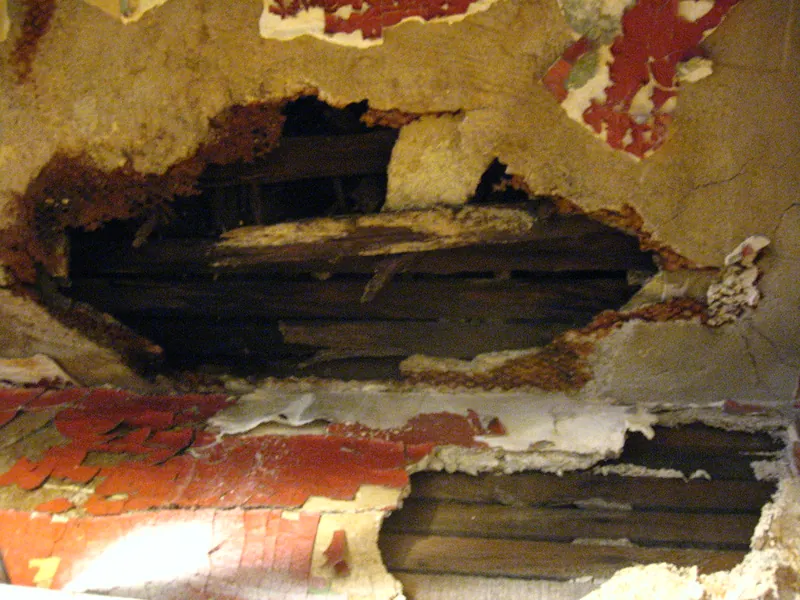
The short version
With ceiling water damage in Acampo, cut power to the room first, then put a bucket beneath the lowest part of the sag and poke a small hole from an angle so it empties slowly. Next, match the timing of the drip to its source. The EPA wants wet materials dry in 24 to 48 hours.
What should I do right away about ceiling water damage in Acampo?
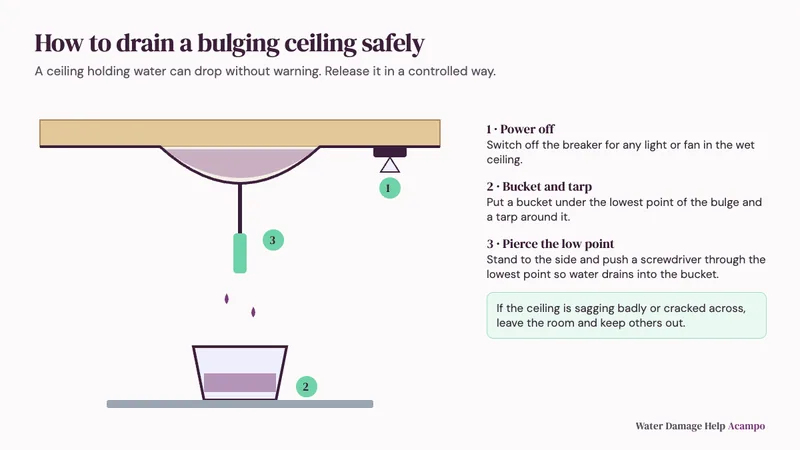
For ceiling water damage in Acampo, make the room safe before you chase the source. Power comes first, then a path for trapped water to escape. Wet drywall is heavy and can drop without warning, so stand to the side of any bulge and work in order.
- Kill the power at the breaker for any light, fan or outlet on or under the wet section.
- Clear the floor of rugs, electronics and furniture, and spread a tarp or old towels.
- Place a bucket under the lowest point of the sag.
- Pierce that low point with a screwdriver, standing at an angle, so the water drains into the bucket instead of onto you.
- Stop the supply if a pipe is feeding the leak by closing the nearest valve or the main shutoff.
- Photograph the ceiling before cleanup and tell your insurer.
The prevention guide shows where main valves usually sit. Once the water stops, the water damage repair page explains the rebuild.
How can I tell a ceiling is about to fall?
Look for a bulge that keeps growing, cracks that spread, tape lifting at seams, screw heads showing through paint, or a spot that feels soft under light pressure. Any of these means everyone leaves the room. Collapse rarely happens with no signs at all.
- A swelling you can hear or see water moving in.
- New cracks along seams or around a light fixture or fan.
- Drips from several points at once.
- Paint or texture that has blistered and hangs in a sheet.
Only a small bulge is worth draining on your own. When a whole panel droops or splits, close the door, switch off power to that room and get help. Never prod a large sag from underneath.
Is this stain from an old leak or one that is still active?
A live leak leaves a stain that feels cool and damp, darkens toward the middle and spreads over days. An old, finished leak leaves a dry stain with a firm brown or yellow edge that stays the same size. Several nested rings mean the leak has come back more than once.
- Press lightly beside the stain. A spongy feel means moisture is still in there.
- Trace the edge with a pencil, then check after the next rain, shower or AC cycle. Growth past the line means water is still arriving.
- Ask for a moisture reading from a restoration provider if you cannot tell by touch.
A dry stain from a repaired leak can be primed and painted. A fresh one means the source is still open, so find it before any cosmetic work. The signs of water damage guide covers stains in other rooms.
What is causing the leak above my ceiling?
Timing is the best clue. Note exactly when the drip starts or the stain grows, and match it to the table below before anyone opens drywall. Water follows joists, wires and pipes, so the stain can sit some distance from the real opening.
| When it happens | Likely source | Trade to call |
|---|---|---|
| Only during or after rain | Shingles or tiles, flashing, a vent pipe collar or a skylight curb | Roofer |
| While the cooling system runs | Clogged condensate drain or an overfull pan | Heating and cooling tech |
| During a shower upstairs | Shower base, tub overflow, cracked grout or a drain gasket | Plumber |
| When the bathroom upstairs gets used | Toilet seal or the supply connector | Plumber |
| Near a water heater set in the attic | Tank body, connections or the relief discharge pipe | Plumber |
| Constant, whatever the weather or use | A supply pipe or joint under pressure | Plumber, with the main valve closed |
Skylights deserve a look when a stain appears under one. The skylight leaks page explains the usual failure points.
Can a winter storm leak through my roof into the ceiling?
Yes. Rain gets past flashing, vent boots, chimneys and damaged roofing, soaks the insulation and later appears as a stain that can be several feet from the opening. A stain that shows only during or after rain points to the roof, not the plumbing.
Wet winters are the norm here. Lodi, the nearest city with climate data, has cool, wet winters with dense ground fog, according to Wikipedia's Lodi article. NOAA Research reports that along the West Coast, a few atmospheric river storms deliver roughly 30 to 50 percent of each year's precipitation.
That means a roof can sit dry for months and then take a week of hard rain. The roof leak page and the atmospheric river prep guide cover the sequence. A roofer closes the opening, and drying the ceiling only works after the rain stops coming in.
Could the air conditioner or a water heater be the source?
Yes, if either one sits above the stained ceiling. A cooling system pulls water from the air and sends it down a condensate line. When that line plugs, water backs into a pan and eventually spills. ENERGY STAR notes that a plugged drain can cause water damage in the house.
Since the water comes from the cooling process, the stain swells while the unit runs and pauses when it stops. Switch the system off if you see water dripping from it. Drying the ceiling will not help while the line stays clogged.
- Look for a damp pan, rust trails or water at the base of a tank.
- For an active tank leak, close the cold water valve above it and shut off the heater's fuel or breaker.
- If your home has neither unit above the stain, rule them out and keep looking.
See AC leak water damage and water heater leaks for the full steps.
Can a water-stained ceiling be saved or does it need replacing?
Board hit briefly by clean water often dries and takes new paint. Board that turned mushy, drooped or flakes apart has lost its strength and is cut away. The call rests on two facts: how many hours it stayed soaked and where the water came from.
- Small stain from a short, clean leak: dry it, seal with stain-blocking primer, then repaint.
- Soft, sagging or crumbling drywall: replace it instead of drying it.
- Wet insulation: holds water against the drywall and framing, so it usually comes out.
- Older plaster over lath: dries slowly and can pull away, so have it checked before anyone stands beneath it.
Ask the provider to read the board and the framing with a moisture meter before anything is closed. Painting damp board traps the water, and the stain returns.
When does the drywall have to come out?
Cut-out is the answer for mushy, drooping or fully soaked-through board, and for board hiding insulation that has no other way to dry. The IICRC S500 standard also ranks water by how contaminated it is, and that rank weighs as much as the visible damage.
| What the ceiling looks like | Usual approach | Reason |
|---|---|---|
| Dry ring from a fixed leak | Prime, then paint | Solid board with the leak already repaired |
| Damp but firm after clean water | Dry where it hangs and verify with a meter | Firm board frequently recovers |
| Soft, sagging or cracked | Cut away and install new board | Soaked gypsum does not regain its strength |
| Wet insulation behind it | Remove insulation, open the ceiling, dry the joists | Water held in the cavity keeps everything damp |
| Sewage or flood water | Take out whatever it touched | S500 classes it as Category 3 |
Under IICRC S500, clean water from a supply line is Category 1. Water from appliances or a toilet overflow with no waste in it is Category 2. Sewage and surface water from outdoors are Category 3. For the cutting and patching steps, read drywall water damage repair.
Will mold show up on a ceiling after a leak?
Yes, when the damp lingers. To head off mold, the EPA points to a 24 to 48 hour drying window for wet areas and belongings, plus indoor humidity under 60 percent, with 30 to 50 percent ideal. Leaks in an attic worry people most, since they can drip for days unnoticed.
Once a stain shows, look at the upper face of the insulation and the roof sheathing from beneath, and take a musty smell seriously. The EPA says that if moldy areas total under about 10 square feet, most people can clean them without help. It also says never to paint or caulk over mold.
The CDC lists a stuffy nose, sore throat, coughing or wheezing and burning eyes among mold symptoms, and says people with asthma or mold allergy can react severely. For sewage or other contaminated water, the EPA advises a professional. See the mold guide and allergies after water damage.
Does California homeowners insurance pay for a damaged ceiling?
The answer turns on where the water came from. Per the NAIC, plumbing failures and roof leaks are typically covered, while ground water, runoff and snowmelt are not. The California insurance department adds that rain entering through a roof opening may be covered if a named cause, wind for example, made the opening.
- Triple-I notes that neglect is excluded, so an insurer may push back on a roof that was worn out.
- Mold cleanup costs are often left out of a policy, the NAIC notes.
- The CDI expects owners to look for the leak at once and stop it where it starts.
Insurers must acknowledge a claim within 15 calendar days of notice, then accept or deny it within 40 calendar days once proof of claim arrives. The CDI consumer hotline is 1-800-927-4357. See the claims guide and the photo checklist.
What if I rent and the ceiling leak is not my fault?
Tell your landlord in writing and keep a copy with dated photos. California Civil Code 1941.1 says a dwelling is untenantable if it substantially lacks effective waterproofing and weather protection of the roof and exterior walls, or plumbing maintained in good working order.
Health and Safety Code 17920.3 lists dampness of habitable rooms and visible mold growth among the conditions that can make a building substandard, and the owner must fix them. A renter's own policy may still help with belongings. The renters and landlords guide explains who handles what.
When is it time to call a restoration provider?
Reach out if the ceiling droops, the insulation overhead is saturated, water has traveled into walls or floors, or the drip went on for several hours. Providers vary in what they take on and how fast they can arrive, so ask each one directly.
- Stop the source, or get the right trade to stop it.
- Photograph and film the ceiling and any wet belongings.
- Ask whether the provider takes moisture readings before and after drying.
- Ask what would be removed and what would be dried in place.
- Have the work scope put in writing first.
If the water came from a split pipe, read the burst pipe guide. For how drying is run, see emergency water damage restoration. When you are ready, contact us to reach a local water damage restoration team.
Sources: IICRC S500; EPA mold and moisture guide; EPA mold cleanup; CDC on mold and health; NOAA Research on atmospheric rivers; Wikipedia on Lodi; ENERGY STAR maintenance checklist; NAIC homeowners page; Triple-I on covered disasters; CDI claims guide; 10 CCR 2695.5; 10 CCR 2695.7; Civil Code 1941.1; Health and Safety Code 17920.3.