The short version
After a sewage backup in Acampo, stop every drain, send kids and pets elsewhere and avoid contact with the water. IICRC rates it Category 3, so soaked carpet and drywall are taken out while hard surfaces are disinfected. Insurance for sewer backup is usually an add-on endorsement, not part of a standard homeowners policy.
What do I do in the first few minutes of a sewage backup?
Shut off every source of drain water and keep people away from the spill. Any extra flush or load of laundry sends more wastewater toward the blockage, and it comes out of the lowest opening in the house. Then phone a plumber and a restoration provider.
- Stop using water: nothing down any drain, including toilets, sinks, showers, the dishwasher and the washer.
- Move children and pets to another part of the house and shut the door on the spill.
- Turn off the breaker for that room, but only from a dry spot. If the panel is in or beyond the wet area, stay out and call an electrician.
- Keep your skin out of it. If something has to be moved, use waterproof gloves and boots, then scrub your hands.
- Take photos of the spill and the drain it rose from before anything is moved. An insurer will want them.
- Find your cleanout if you have one, and read the section on who to call below.
The extraction itself falls to a restoration provider. The water removal page explains how pumping and removal work, and each provider should tell you directly what it takes on and when.
Where does the sewage come from: a public main or my own line?
Either can fail. A clog in the pipe running from your house out to the main is one source, and trouble in the main itself is the other. In both cases the wastewater climbs out of the lowest drain it reaches.
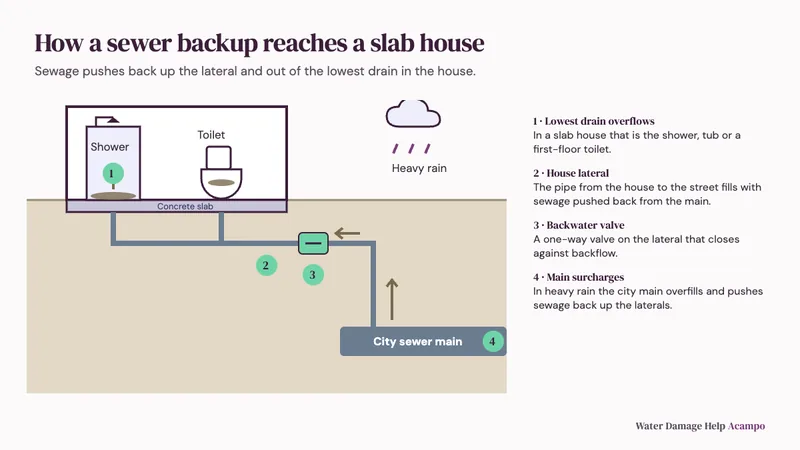
Backups usually trace to one of three places:
- Your private line, blocked by grease, wipes, roots or a cracked pipe.
- The public main, when it is blocked or overloaded and several homes on a street are hit.
- A clog inside the house, which normally shows at one fixture, not at the lowest drain.
When several neighbors share the problem, suspect the main. San Joaquin County is a flat basin with a high water table, and winter storms can load the system, so wet weather is a good time to watch your drains.
How does IICRC rank sewage water, and why does it change the cleanup?
IICRC S500 places sewage in Category 3, the most contaminated class, next to rising river water and outside surface water. Because it carries bacteria and other pathogens, soft materials it soaks into cannot be made safe again and are normally removed.
The EPA says to bring in a professional experienced with buildings hit by sewage or other contaminated water. A mop, an all-purpose cleaner and a shop vacuum will not do it.
- Soft goods such as carpet, pad, wet drywall and upholstery are removed and discarded.
- Sealed hard surfaces, tile and concrete are cleaned, then disinfected.
- Air movers and dehumidifiers run after that, never before.
If the water came in from outside rather than from a drain, see flood cleanup in Acampo, which is also Category 3.
When is an overflowing toilet grey water, and when is it sewage?
It depends on what the water carries and where it came from. IICRC S500 treats a toilet overflow with no waste in it as Category 2, grey water. Water that holds waste, or that rose out of a floor drain, tub or shower, is Category 3, and that category decides what is dried and what is discarded.
| What happened | Category (IICRC S500) | What usually follows |
|---|---|---|
| Toilet bowl overflows, clear water | Category 2, grey water | Disinfect and dry, with the provider judging what is salvageable |
| Washing machine or dishwasher spill | Category 2, grey water | Dry out after checking which finishes absorbed it |
| Toilet overflow with waste in it | Category 3 | Soft materials come out, hard surfaces are disinfected |
| Wastewater up a floor drain, tub or shower | Category 3 | Line cleared first, then removal, disinfection and drying |
| River or storm water indoors | Category 3 | Handled under the same rules as sewage |
If you cannot tell which kind you have, treat it as Category 3 until a professional has looked.
What if my home is on a septic system instead of a sewer?
Then there is no public main to blame, and the problem sits on your own property. Which kind of system serves your address is something to confirm with your county or your records, because it is not the same for every home around Acampo. A septic backup still counts as sewage.
Call a septic service professional rather than a general plumber if the tank or drainfield is the suspect. The EPA says the average household system should be inspected at least every three years and that tanks are typically pumped every three to five years.
- Keep cars and heavy equipment off the drainfield.
- Keep roof drains and sump pump discharge away from it.
- Do not pour grease down the drain or flush wipes, which the EPA lists among the things never to flush.
The EPA also suggests a drain snake or boiling water over chemical drain openers, which can harm the living organisms in a septic tank.
Who should avoid the room during a sewage backup?
Everyone who has no job to do in there. Raw sewage holds bacteria and other disease-causing organisms. Until the space is cleaned and dry, keep out young children, older adults, pregnant people, anyone with a lung condition or weakened immune system, and anyone with broken skin.
- A closed door keeps odor and airborne droplets from drifting through the house.
- When entering cannot be avoided, put on goggles, waterproof gloves and boots, and rinse off with soap and clean water after.
- Eating, drinking and smoking stay outside the affected area.
- Phone a doctor if illness follows contact or a wound touched the water.
The CDC's cleaning advice for hard surfaces runs from soap and water up to a bleach solution of no more than 1 cup per 1 gallon of water. Bleach should never be combined with ammonia or other cleaners.
What gets thrown away after a sewage backup, and what can be cleaned?
Porous things the sewage soaked into are thrown out, while sealed hard surfaces can usually be cleaned and disinfected. How much of the house lands in each group depends on how far the water traveled and what the floors and walls are made of.
- Wall-to-wall carpet and its padding.
- Insulation and drywall that wicked the water upward, cut out above the stain line.
- Cabinets and shelving made of particleboard.
- Couches, area rugs, mattresses and plush toys.
- Boxes, books and papers, along with food or medicine in reach of the water.
Metal, glass, hard plastic, tile and concrete usually survive disinfection. Solid wood and washable clothing are worth asking a provider about before they go in the trash. Photograph every item first for the adjuster.
The EPA also cautions against covering suspected mold with paint or caulk.
What steps does sewage cleanup follow, and when is it dry?
The work goes in a fixed order: stop the source, remove the sewage and ruined materials, clean and disinfect, then dry. A small spill on tile is a short job. A carpeted room with wet drywall takes longer, and the provider can tell you more after seeing the damage.
- Clear the line. A plumber or septic professional stops the backup at its source.
- Extract and remove. The provider pumps out the sewage and takes out porous materials.
- Clean and disinfect the hard surfaces that stay, including the subfloor or concrete.
- Dry with air movers and dehumidifiers until moisture readings are back to normal. The CDC and the EPA both advise drying within 24 to 48 hours to head off mold.
- Rebuild flooring, drywall and trim once everything reads dry.
The structural drying page explains how readings are taken. If anything stayed wet longer, read mold after water damage.
What makes sewage cleanup cost more or less?
The price follows the size of the affected area, the amount of soft material that must be removed, the time the sewage sat and the rebuilding afterward. Category 3 jobs add protective equipment, containment and disposal. A figure only means something after a provider has inspected the damage.
- Footprint: a single bathroom or a string of rooms.
- Materials: flooring, wallboard, cabinets and trim that must be cut out.
- Delay: the longer sewage sits, the deeper it soaks.
- Pipe repair: the plumber's or septic company's work is billed apart from the cleanup.
The restoration cost guide covers what drives the range, using national figures.
Does homeowners insurance pay for a sewage backup?
Typically only if you bought the extra coverage. According to Triple-I, standard homeowners policies leave out sewer backups, and so does flood insurance. Protection is sold on its own or as an endorsement, so look at your policy now, not after a loss.
The California Department of Insurance says an earthquake policy does not pay for water damage that starts outside the home, including sewer or drain backup. A backup from your own plumbing may be treated differently from one that comes from the street, so ask your agent which applies.
With the endorsement in place, report the loss at once. Under Title 10 of California's regulations, the insurer gets 15 calendar days to acknowledge your notice, then 40 calendar days after proof of claim to say yes or no. If you are stuck opening a claim, the Department of Insurance consumer line is 1-800-927-4357.
The insurance claims guide has the full steps, and flood vs homeowners insurance covers the outside-water side.
How do I keep sewage from backing up again?
Stop putting grease and wipes down the drains, get the line inspected after any repeat backup, and ask a plumber about a backwater valve. The valve passes wastewater out of the house and shuts when sewage tries to return, so it protects the lowest drains.
- Scrape cooking grease into the garbage and wipe greasy pans before washing them.
- Keep wipes out of the toilet, even the ones labeled flushable.
- Request a camera inspection if roots grow near the line or several drains run slow.
- Ask a plumber whether a backwater valve suits your pipe and if a permit applies.
- Ask your agent whether a sewer backup endorsement is offered.
Fix the line before rebuilding anything, because a second backup would ruin the new flooring. The prevention guide has a longer checklist.
Who do I call: a plumber, the sewer agency or a restoration provider?
Possibly all three. A plumber handles your private line, the agency running the public sewer handles trouble in the main, and a restoration provider deals with the rooms the sewage reached. With a septic system, a septic professional takes the place of that agency.
- Photograph the cleanout cap and any standing water you see.
- When neighbors report the same trouble, say so on your call.
- Get a short written note from the plumber on where the blockage sat, since insurers and agencies may ask.
Not every provider takes sewage jobs, so ask first and confirm before anyone drives out.
The page on choosing a restoration company lists questions to ask. If the backup came with storm water, atmospheric river prep covers what winter storms can do. The county page for San Joaquin County lists the nearby communities served.
Sources: IICRC S500; EPA, cleaning up mold at home; EPA, mold and moisture brief guide; EPA, How to Care for Your Septic System; CDC mold and health page; Triple-I on covered disasters; CDI earthquake insurance brochure; 10 CCR 2695.5; 10 CCR 2695.7; CDI consumer help.