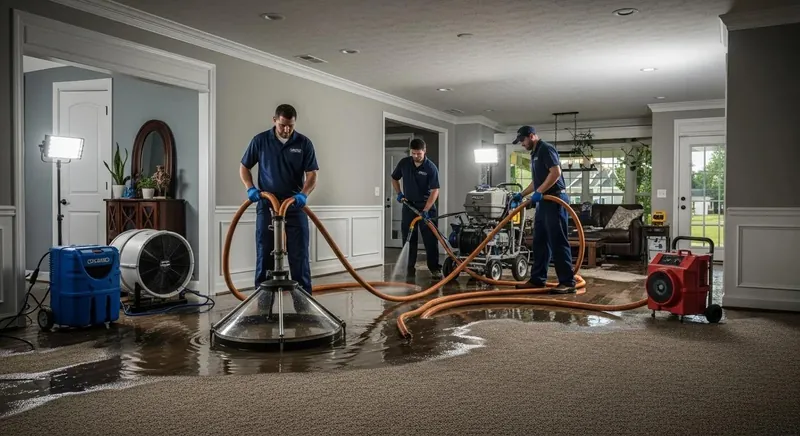
The short version
For burst pipe water damage in Acampo, close the nearest shutoff or the main valve, open a low faucet, photograph everything and call a plumber for the pipe. Ask a restoration provider about drying. Wet materials should dry in 24 to 48 hours, the EPA says, to prevent mold.
What do I do first when a pipe bursts in my Acampo home?
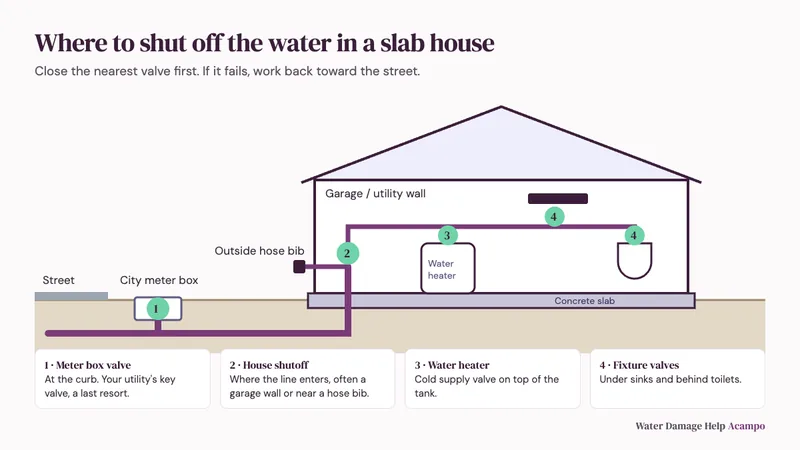
Burst pipe water damage in Acampo gets worse every minute the supply stays open, so stop the flow before anything else. Turn off the valve closest to the break, or the main house valve when the source is unknown. Then keep everyone out of wet areas that have outlets or cords.
- Shut the closest valve. If the break is hidden, close the main valve where the line enters the house. The meter box near the street has a utility valve that is not yours to turn.
- Relieve the pressure. Run the lowest tap in the house so less water pushes toward the split.
- Protect the electrical side. Flip the breaker for wet rooms only when the panel is dry and you can reach it on dry ground.
- Record the scene. Film the pipe, the pooling water and each soaked item before anything gets moved.
- Call a plumber for the pipe and your insurance company for the claim.
- Ask a restoration provider about water removal and drying while the plumber works.
If water is pooling above a ceiling, stay out from under it. The ceiling water damage page shows how a bulge is drained safely, and the emergency water damage page explains what happens once the water is off.
Do pipes freeze and split around Acampo?
They can on a hard cold night, though this site has no local freeze statistics to quote. Lodi, the nearest city with climate data, has cool, wet winters with dense ground fog and hot, dry summers, according to Wikipedia's Lodi article. Cold snaps matter most for pipes outside the heated space.
The American Red Cross says supply pipes in unheated interior areas such as crawl spaces, attics, garages and kitchen cabinets are the most at risk. If your house has any of those, that is where a cold night does its damage.
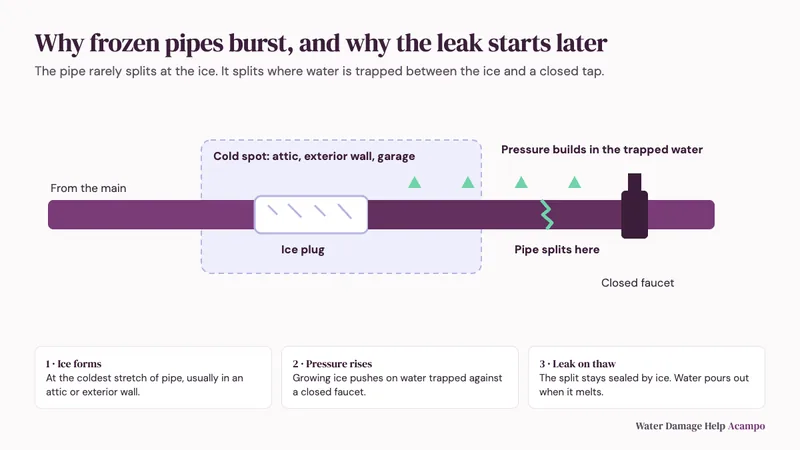
A frozen pipe often splits quietly. Ice plugs the line, pressure builds between the plug and a closed tap, and the pipe gives way. The water only shows up once the ice melts.
Farm and ranch outbuildings, irrigation risers and exterior hose bibs share the same weakness, because they hold standing water in exposed pipe.
How do I thaw a frozen pipe without making things worse?
Open the tap first, then add gentle heat starting at the tap end. The Red Cross names four safe heat sources: an electric heating pad, a hair dryer, a portable space heater placed well away from flammables, and towels wrung out of hot water. Work toward the colder section as the ice clears.
- Leave the tap open so melting ice has somewhere to go.
- Per the Red Cross, never use a blowtorch, a kerosene or propane heater, a charcoal stove or other open flame.
- If the frozen section is inside a wall or ceiling, stop and call a plumber instead of cutting blindly.
- If you already see a split, close the main valve before any heat goes on.
After the thaw, walk through the house. Look for drips, damp drywall and fresh ceiling stains. A pipe that thawed without spraying can still be cracked, and the crack shows up once pressure returns.
Can water pressure alone burst a pipe?
High pressure wears on every joint and fitting, and it can contribute to a rupture. The Department of Energy's Building America Solution Center says most plumbing codes call for a pressure reducing valve where supplied pressure goes above 80 psi, and that excess pressure can rupture pipes and damage fixtures.
The same source says keeping static pressure at or below 60 psi reduces leaking faucets, water heaters and ruptured pipes or hoses. A plumber can test your pressure with a gauge at a hose bib and tell you whether a valve is installed and set correctly.
This is worth asking about after any burst that had no cold weather behind it. A pipe that failed in July points to age, pressure or a bad fitting, not frost. The DOE guide explains how the valve works.
Where in a house do burst pipes tend to show up?
They show up wherever a pipe is cold, old, stressed or hard to see. The table below pairs each spot with the first sign and the right person to call. It is written as a checklist, because this site cannot say which kinds of foundation or pipe materials homes in Acampo have.
| Spot in the house | Why it fails | What you might see | Who handles it |
|---|---|---|---|
| Attic supply lines | Cold air reaches thinly covered pipe | Ceiling stain or drip below | Plumber, then a restoration provider |
| Crawl space lines, if your home has one | Unheated, often damp, rarely checked | Soft floor, musty smell, wet insulation | Plumber |
| Garage and water heater supply | Unheated space with exposed pipe | Water on the garage floor | Plumber |
| Hose bibs and irrigation risers | Standing water in exposed pipe | A wet wall or spray at the spigot | Plumber or irrigation installer |
| Lines under a slab floor, if your home has one | Corrosion, wear or ground movement | Warm floor patch, a meter that keeps moving | Plumber with leak detection |
Underfloor leaks behave differently from a freeze split, and the slab leak page covers those warning signs. The signs of water damage guide walks room by room.
How can I tell whether a pipe is leaking inside a wall or ceiling?
Look for slow changes over days: a stain that keeps spreading, paint that bubbles, a damp smell or a bill that climbs while habits stay the same. The EPA's WaterSense program says that if your meter moves while no water is in use, you probably have a leak.
- Stop all water use and check that the dishwasher, washer, ice maker and irrigation are idle.
- Read the meter or photograph the dial, then wait and read it again.
- Look for soft, warm or darkened spots on walls and ceilings, and press lightly on the paint.
- Ask a plumber for a pressure test or listening equipment rather than cutting a hole to look.
- Ask for moisture readings on any surface that looks suspect.
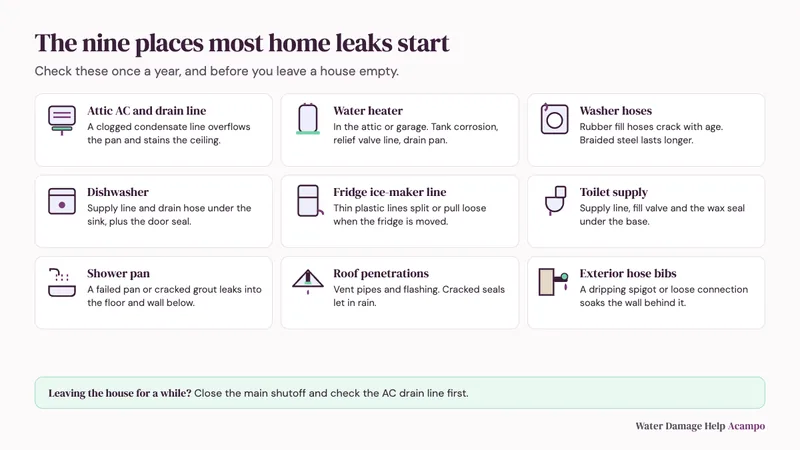
Water in a ceiling can also come from the air conditioner or a water heater. Compare notes with the AC leak page and the water heater leak page. Details on the EPA check are on its Fix a Leak Week page.
Does California homeowners insurance pay for a burst pipe?
Often it pays for the water damage when the break is sudden, though your policy wording decides. The Insurance Information Institute names accidental discharge or overflow of water from plumbing, and freezing of those systems, as perils on standard forms.
According to the NAIC, a home's own plumbing leak is typically covered, but ground water and rain runoff are not. California's insurance department adds that homeowners policies leave out flood yet cover other kinds of water damage.
- Damage from poor upkeep is excluded, Triple-I notes.
- Mold is often limited or excluded, according to the NAIC.
- The CDI describes the California FAIR Plan as a bare-bones policy for fire and smoke that requires a separate policy for water damage and other common perils.
In 2023 water damage and freezing accounted for 22.6 percent of homeowners insurance losses, Triple-I reports. Read the insurance claims guide for the full process, and flood vs homeowners insurance if river water is involved.
What deadlines does a California insurer have after a burst pipe claim?
State regulations set the clock. Your insurer has 15 calendar days after notice to acknowledge the claim and 40 calendar days after proof of claim to accept or deny it. Payment is due 30 calendar days after acceptance. These are sections 2695.5 and 2695.7 of Title 10 of the California Code of Regulations.
An insurer that needs longer must send written notice inside the 40 days, then again every 30 calendar days until it decides. A denial must be in writing and list every reason. It must also tell you that the Department of Insurance can review the matter.
The CDI says to report water damage to your agent or company right away. If you have trouble opening a claim or disagree with the answer, call its consumer hotline at 1-800-927-4357 or file a complaint on the CDI help page.
Triple-I also suggests protecting the property, keeping receipts, and waiting on large permanent repairs until the adjuster has assessed the loss.
What water category is a burst pipe, and how does the drying work?
A burst supply line usually releases Category 1, clean water, under the IICRC S500 standard. Water that sits, crosses dirty surfaces or soaks into materials for a long time can move to a higher category, so a provider confirms it on site before choosing a drying plan.
- Source stopped and standing water extracted.
- Wet materials removed when they cannot be saved, such as soaked insulation or swollen drywall.
- Air movers and dehumidifiers set to dry what remains.
- Readings logged at each visit to show the drying is working.
- Repairs started only after the materials read dry.
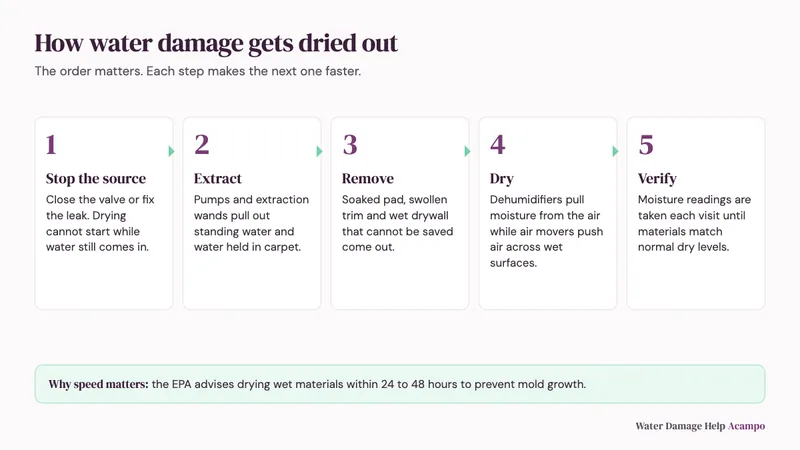
To prevent mold, the EPA says to dry water-damaged areas and items in the first 24 to 48 hours. Learn more about water removal and structural drying. Restoration teams differ in scope, so confirm what each one includes.
Who can I hire to fix a burst pipe, and what should I check first?
Hire a plumber for the pipe and confirm the license before work starts. The Contractors State License Board says small projects of up to $1,000, labor and materials included, may be done without a license only if the person hires no workers and no building permit is needed.
That $1,000 limit took effect January 1, 2025 under Assembly Bill 2622. A burst-pipe repair with a crew or a permit falls outside it, so ask for a license number and look it up with CSLB.
- Under CSLB rules, a down payment is capped at the lesser of $1,000 or 10 percent of the contract price.
- Pay as work is finished, and put every change in a written change order.
- An emergency repair you request on short notice has a different cancellation rule than a normal home improvement contract. Read the contract before you sign.
The guide to choosing a restoration company adds questions to ask a drying provider. CSLB's contact line is 800-321-2752, and its site is CSLB Hire a Contractor.
How do I keep pipes from bursting this winter?
Insulate exposed pipe, keep the heat steady and know where your main valve is. The Red Cross advises a steady thermostat setting around the clock, never below 55 F while you are away, plus a slow cold drip at faucets fed by exposed pipes.
- Wrap pipes in attics, garages and any crawl space with insulation made for pipe.
- Disconnect garden hoses and protect hose bibs and irrigation risers before a cold snap.
- Open cabinet doors under sinks on outside walls so room air reaches the pipes.
- Test the main shutoff so you know it turns before you need it.
- Have a plumber test your water pressure against the 60 and 80 psi marks above.
The prevention guide has a year-round list. If storms are the bigger worry, see atmospheric river prep.
Sources: Red Cross on frozen pipes; Wikipedia on Lodi; DOE service water pressure guide; EPA WaterSense leak week; Triple-I on covered disasters; Triple-I on settling claims; NAIC homeowners page; CDI claims guide; 10 CCR 2695.5; 10 CCR 2695.7; CDI, file a complaint; CSLB press release 24-21; CSLB, Terms of Agreement; IICRC S500; EPA mold and moisture guide.