The short version
Most AC leak water damage in Acampo starts when a clogged condensate line lets the drain pan overflow. Shut the system off, catch what drips, and have an HVAC technician find the cause. The EPA advises drying wet insulation and ceiling board in 24 to 48 hours to head off mold.
What makes an air conditioner leak water inside a house?
The usual culprit is the condensate drain, since cooling wrings moisture from indoor air and sends it off through a small drain line. If that line clogs, the pan beneath the coil fills and spills over. Hot Central Valley summers keep equipment running for long stretches, so a marginal drain fails sooner.
The spill lands wherever the air handler is mounted. If yours sits in an attic or a closet, the first warning is often a stain on the ceiling or wall nearby. The water mitigation page explains the drying that follows.
| Likely cause | What you see | Who handles it |
|---|---|---|
| Clogged condensate line | A full pan, a damp ceiling, or a unit that shuts itself off | HVAC technician |
| Rusted or cracked drain pan | Drops under the unit even when the line runs clear | HVAC technician |
| Iced-over evaporator coil | Thin airflow, frost on the coil, a sudden gush on thawing | HVAC technician |
| Cold duct or line sweating | Moisture beads on metal and damp insulation beside it | HVAC technician or insulation contractor |
| Wet ceiling, insulation or wallboard | Stains, a sag, spongy spots, a stale odor | A restoration provider first, then a repair contractor |
What do I switch off and do first when the AC drips?
Shut the system down at the thermostat, and at its breaker if the panel is dry and easy to reach. While the unit runs it keeps making water. After that, collect the drips, shield whatever is underneath, and ask an HVAC technician to find the cause.
- Switch the thermostat to off, and trip the air handler breaker as well when you can do so safely.
- Stay out of an attic that is dripping. Wet insulation near wiring can shock you.
- Place buckets and towels under drips and slide furniture and rugs clear.
- Inspect the ceiling. A bulge full of trapped water is covered in draining a bulging ceiling safely.
- Photograph the pan, the stain and any pooled water before wiping anything.
- Phone an HVAC company. If insulation, ceiling or walls are wet, ask for a restoration provider too.
Keep the unit off until the drain is open, or it will just refill the pan.
How does a plugged condensate line turn into water damage?
Algae, slime and dust gradually narrow the drain line until water cannot get out. The backed-up water fills the pan beneath the air handler, climbs over the rim and drips onto whatever is below. ENERGY STAR warns that a blocked condensate drain can damage the house and change indoor humidity.
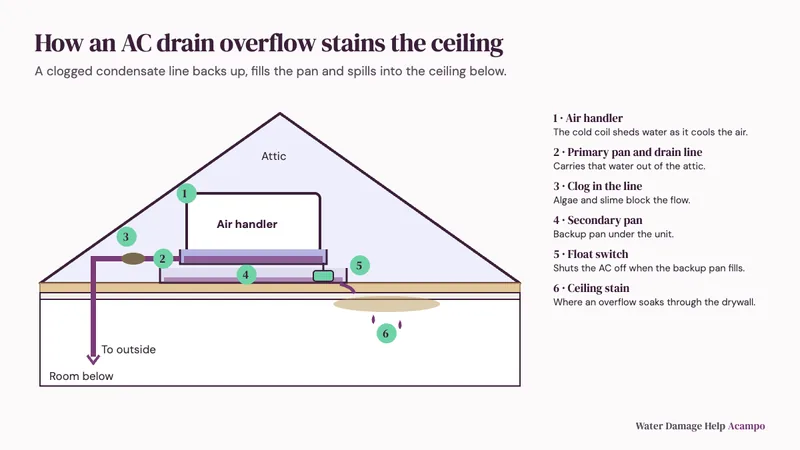
The line is typically a slim plastic pipe leading from the air handler to the outdoors or to a drain. Its small bore clogs readily, and a technician can clear it. The EPA's moisture guidance turns this into a chore: keep drip pans clean and drain lines unobstructed.
What do the drain pan and float switch do?
One pan sits under the coil and gathers the condensate. Some systems add a backup tray beneath the entire air handler, and some include a float switch that cuts power when water climbs. Such parts keep a single clog from becoming a collapsed ceiling.
- Coil pan: receives the water the coil sheds and passes it to the drain.
- Backup tray: a wider tray below the unit. Water standing in it signals that the first drain has failed.
- Float switch: shuts the equipment off once the pan fills. If it is absent or stuck, the water keeps coming.
- Overflow outlet: a few systems have an extra drain that spills in a visible spot, such as over a window. A drip there is an alarm.
What your home has depends on when the system was installed and by whom. Your HVAC company can tell you what is fitted and what could be added. The prevention guide covers other protective devices.
How can I tell an AC leak from another kind of leak?
Notice the timing, the location and the temperature of the water. Condensate is cool and clear. A drip that begins only while cooling runs points at the air handler, while one that continues with the system off may come from a supply pipe, the water heater or the roof.
- Drips during cooling only: think drain, pan or iced coil.
- Warm water, or a flow that never stops: look at the water heater and supply pipes, starting with the water heater leak page.
- Wet only after a storm: likely the roof, covered in roof leak and storm damage.
- Moisture beading on a chilled pipe or duct: condensation rather than a break.
Our signs of water damage guide separates a single overflow from a slow drip, and the high water bill page covers supply leaks.
What does a ceiling leak from the AC actually damage?
Water soaks into insulation first and the board below it next, so the harm usually reaches past the visible stain. An occasional overflow leaves a ring that reappears each time. A steady drip softens the board until it sags, and soft board generally has to come down.
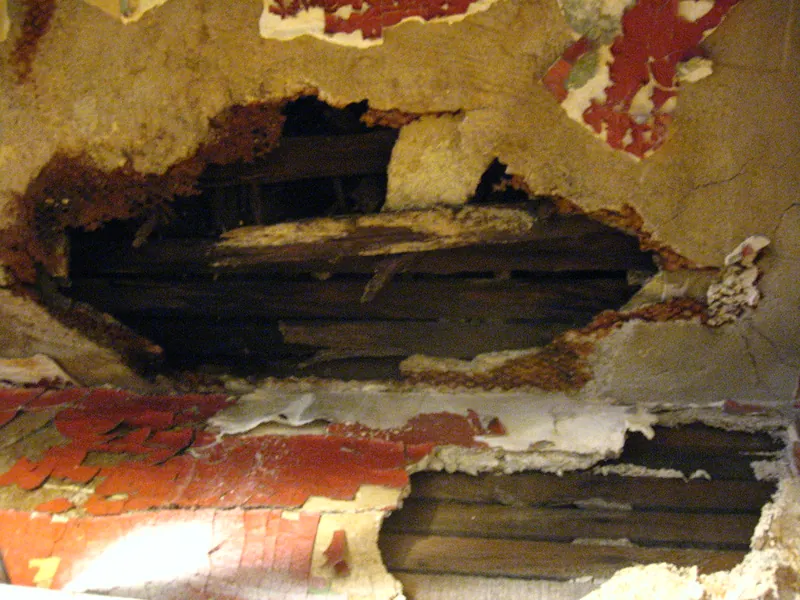
- Insulation: once soaked, it keeps water pressed against the ceiling above the room.
- Drywall or plaster: discolors, goes soft and can fall in pieces.
- Paint: new coats show the old stain until the leak is stopped.
- Wiring and fixtures: water may reach them, so leave the power off to a wet ceiling.
What happens to the board is explained in drywall water damage repair, and the rebuild appears under water damage repair.
Does a sweating duct count as an AC leak?
Not exactly, though the damage looks similar. Chilled ducts and lines gather moisture when warm air meets them, and the drops can fall on insulation or ceilings. The remedy is usually better insulation or sealing, rather than a drain repair, so the first job is working out which one you have.
According to the EPA, moisture collecting on windows, walls or pipes can point to high humidity, and rust on a drainpipe shows that condensation forms there. Its advice is to wrap cold water pipes in insulation.
- Ripped or absent duct wrap exposes cold metal.
- Openings around the air handler let warm air touch chilled parts.
- Uncovered drain or refrigerant lines can drip along their whole run.
One visit from an HVAC technician is often enough to tell sweating from a leak. Methods differ, so ask what gets checked.
Can water from an AC leak lead to mold?
Yes, if the soaked materials stay soaked. The EPA's rule of thumb is to get damaged areas and belongings dry inside 24 to 48 hours. Leaks above a ceiling can drip for days without anyone seeing, so insulation and the back of the board are frequent trouble spots.
The EPA names the back of drywall and the top of ceiling tiles as hiding places for mold.
- Humidity: indoor levels should stay under 60 percent, and ideally between 30 and 50 percent, per the EPA.
- Small patches: a spot under roughly 10 square feet is a job most people can manage, the EPA says.
- Large or concealed growth: hire a professional and never cover it with paint or caulk.
- The HVAC system: if you know or suspect mold inside it, the EPA says leave it off.
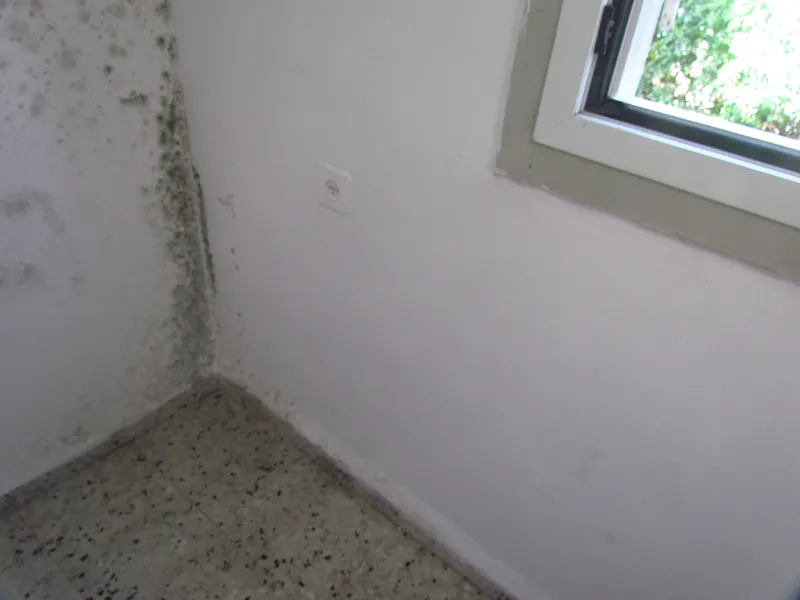

For testing and removal decisions, see the mold after water damage guide.
What can ceiling and drywall repair cost after an AC leak?
Price depends on how much is wet and what the finish is. Nationally, Bob Vila's 2023 cost guide lists ceiling repair at $350 to $1,250 and drywall at $1.50 to $3 per square foot. California prices can differ, and an inspection is the only way to get a real figure.
- Drying comes first: wet board and insulation are dried or taken out before patching starts.
- Extent: one stain costs less than a whole room's ceiling.
- Finish: matching texture and paint adds labor.
What drives such ranges is laid out in the restoration cost guide. Providers set their own terms, so confirm them directly.
Does homeowners insurance pay for AC leak water damage?
Often for the water damage, but not for fixing the air conditioner. Triple-I lists accidental discharge or overflow from plumbing, heating and cooling systems among the named perils on standard forms. Neglected maintenance and mold are handled differently, so read your own policy.
Triple-I also says policies exclude damage from poor upkeep, and an insurer might argue that about a drain nobody ever serviced. The NAIC notes that mold is often excluded as well.
- Notify your insurer promptly and take sensible steps to limit further damage.
- Document the pan, the stain and the attic before any cleanup.
- Save receipts from emergency work.
- Keep ruined items for the adjuster, and collect written bids.
Under California's claims rules an insurer has 15 calendar days to acknowledge a claim and then 40 calendar days after proof of claim to decide. The insurance claims guide walks through the steps.
Who handles which part of the job after an AC leak?
Three different trades are usually involved, in a set order. An HVAC company fixes the cause, a restoration provider dries and removes wet materials, and a repair contractor rebuilds the ceiling or wall. Doing them out of order tends to mean paying for the same repair twice.
- HVAC technician: clears the drain, checks the pan and switch, and finds why the water backed up.
- Restoration provider: measures moisture, removes wet insulation and board, and dries the cavity.
- Repair contractor: replaces board, texture and paint once readings are normal.
The California Contractors State License Board says unlicensed work is limited to projects of $1,000 or less, labor and materials included, and only when no workers are hired and no permit is needed. Ask each company about its license, and see choosing a restoration company for questions to put to a provider.
How do I keep the AC drain from overflowing again?
Get the drain inspected on a schedule, test the pan and float switch, and watch for early signs. ENERGY STAR recommends a yearly contractor visit before the cooling season, and says a standard check-up includes the condensate drain. A small habit now can spare you a ceiling repair later.
- Schedule the yearly service, ideally in spring, and ask for the drain line to be cleared.
- Ask whether a float switch is on the pan, and whether it works.
- Inspect, clean or replace the filter monthly, as ENERGY STAR advises.
- Peek at the overflow outlet or backup tray whenever you can reach it safely.
- Wrap uncovered cold lines and patch torn duct wrap.
Ceiling stains sometimes come from an appliance or the roof instead. The appliance leak page goes through the other likely sources, and the San Joaquin County page lists the nearby communities served.
Sources: EPA, mold and moisture brief guide; ENERGY STAR, heating and cooling maintenance checklist; Triple-I on covered disasters; NAIC homeowners insurance page; Bob Vila, water damage restoration cost; 10 CCR 2695.5; 10 CCR 2695.7; CSLB press release on the $1,000 handyperson exemption.