The short version
Bathroom water damage in Acampo starts with the fixture valve. Then blot standing water, empty wet cabinets and take photos. Plumbers repair the source, and a restoration provider dries floors, cabinets and walls. The EPA puts the drying target at 24 to 48 hours.
What should I do first after a bathroom or kitchen leak near Acampo?
Stop the water at the fixture, then deal with what is already wet. Bathroom water damage in Acampo, or in a kitchen, usually starts under a sink, behind a toilet or inside a shower wall. Closing one small valve limits everything that follows.
- Turn the fixture's own valve clockwise. It sits under the sink, or on the wall or pipe behind the toilet.
- If the valve will not move, close the main house shutoff and open one faucet to drain pressure.
- Blot standing water and lift rugs, bath mats and stored items off the wet floor.
- Empty the wet cabinet and prop the doors open so air can reach the back.
- Photograph the fixture and every wet surface before cleanup.
- Call a plumber for the source, and ask for a restoration provider if the floor, wall or ceiling got wet.
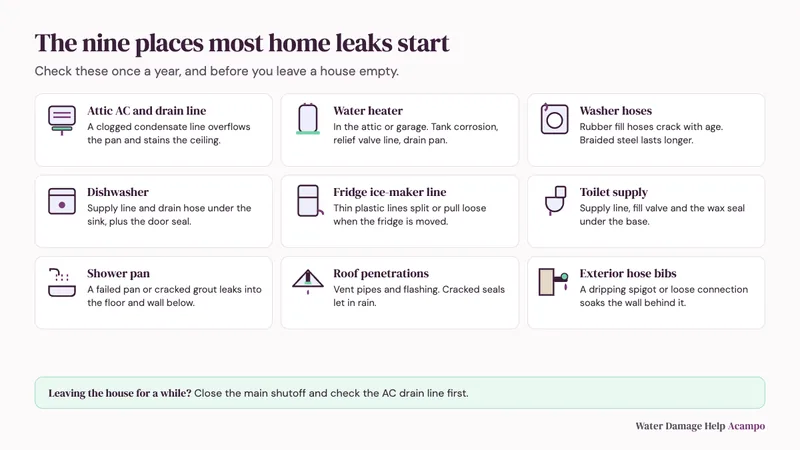
If you cannot tell where the water starts, the guide to signs of water damage lists the clues. A tank heater is a separate topic on the water heater leak page.
Which fixture is the source of the leak, and which trade repairs it?
Each fixture fails in its own way, and repairing the source is normally a plumber's job. The table below lists the usual suspects, what each one looks like and what to shut off. A restoration provider arrives after the leak is stopped to dry the damage.
| Fixture | Warning sign | What to shut off | Who repairs it |
|---|---|---|---|
| Shower pan or wall | Spongy floor beside the stall, loose tile, a stain below | Stop using the shower | Plumber or tile contractor |
| Tub drain or overflow | Water appears as the tub fills or drains | Close the tap and empty the tub | Plumber |
| Toilet seal or supply line | Damp floor at the base, a bowl that rocks | Valve behind the bowl | Plumber |
| Sink supply or trap | Wet cabinet floor, drips only while draining | Stop valves under the sink | Plumber |
| Faucet body | Water pooling at the base or handle | Stop valves under the sink | Plumber |
| Dishwasher or disposal | Damp odor, drip from the housing, swollen cabinet side | Stop using it and close its supply | Plumber or appliance installer |
Washers, refrigerator lines and dishwashers are covered in more detail under appliance leak water damage, and toilet failures on the toilet supply line page.
How can a leak hide behind tile or a shower wall?
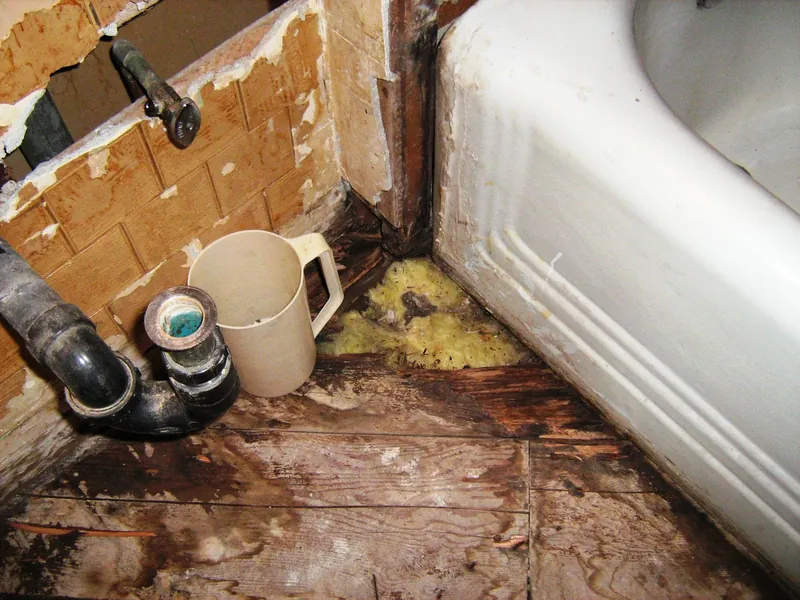
Tile does not soak up water, but the backer board, mortar and wood behind it do. A leak can run for weeks while the surface looks normal. Check beside and below the shower, since a failing pan or wall seldom shows in the stall itself.
- Grout that has cracked or gone missing gives water a path in.
- Tile that sounds hollow when tapped may have lost its bond.
- Dark lines that keep returning after scrubbing can signal moisture rising from below.
- A soft patch of floor next to the tub means the framing may be wet.
To test a pan, a plumber can plug the drain and see whether the level falls. A moisture meter against the neighboring wall shows how far the water has crept. Fresh grout is only a surface patch. When water has reached the backing, the wall or floor has to be opened and dried first, and only then sealed.
Wet walls beside a tub need the same decision as any wet drywall, covered in drywall water damage repair.
Can soaked cabinets and countertops be saved?
Solid wood often recovers, while particleboard usually does not. Wet cabinets show swelling along the bottom edge, bubbling veneer, a soft floor and a musty smell. The material decides most of the outcome, so ask the provider which pieces can stay and why.
Particleboard and MDF take on water, swell and lose strength, and drying does not shrink them back. A door with a puffy edge is mostly cosmetic. A swollen floor under a sink is structural.
To dry the space behind and under the box, a provider may take off the toe kick and drill small vent holes. Photograph everything before demolition, because an adjuster will ask to see it. Stone and laminate countertops tend to survive, but one glued to swollen particleboard may have to go.
What happens to the floor beneath a tub, vanity or sink?
Wood under the finished floor stays wet longer than the surface does. Beneath a tub, vanity or kitchen sink it can remain damp for weeks with no sign above. What you do next depends on how your own house is built.
Records for Acampo do not say which foundation type is common, so check yours. If the bathroom sits on an upper floor, water can drop through to the ceiling below, and framing can soften if it stays wet. If the floor is concrete, it will not rot but can hold moisture under flooring. If your house has a crawl space, water may collect there, and the water-damaged floor repair page covers what to do.
Watch for a floor that sags, edges that lift, a stain that returns and a damp smell. A provider checks with a moisture meter and opens the cabinet or floor only when the readings call for it.

How should I handle an overflowing toilet?
Shut the valve behind the bowl. If the tank keeps running, lift the lid and press the flapper closed. Then judge the water. IICRC S500 lists an overflow that carries no waste as Category 2, grey water, and one with waste as worse.
Treat Category 2 water carefully: gloves on, children and pets out, and no do-it-yourself drying of soaked material. If the water comes up through a floor drain or the lowest fixture instead of the bowl, suspect a sewer backup. Sewage backup cleanup covers that case.
If the bathroom is upstairs, expect the water to slip past the toilet flange and tub drain and mark the ceiling below. Kids and pets cleanup safety explains how to keep them clear.
Why is there a stain on the ceiling under the bathroom?
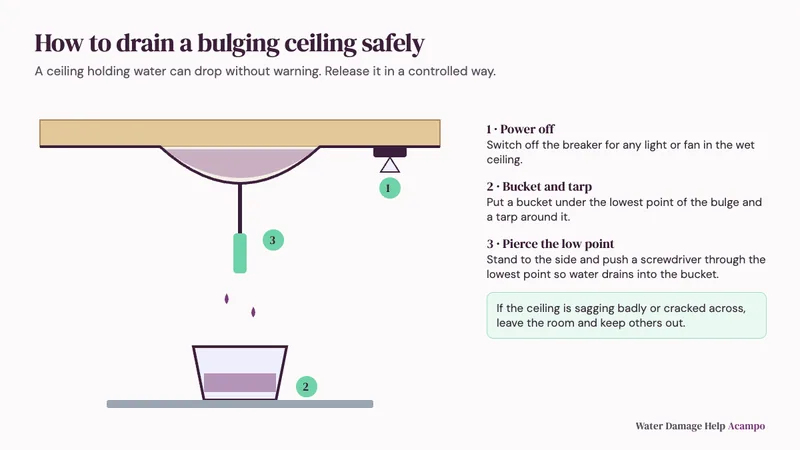
Water traveled down through the floor. In a two-story house, an upstairs shower, tub or toilet leak shows up in the ceiling below, often well away from the source. Do not poke a bulging ceiling without a plan for where the water will go.
Tell the provider which upstairs fixture you suspect, since the origin matters as much as the stain. A kitchen under a bathroom can be hit the same way. The ceiling water damage guide shows how to relieve a bulge safely.
How do water categories apply to fixture leaks?
Where the water came from sets the category. IICRC S500 defines three: Category 1, clean supply-line water; Category 2, grey water from a washer, dishwasher or waste-free toilet overflow; and Category 3, the worst class, which covers sewage and rising flood water.
Supply-line water starts out as Category 1, while drain water is never clean. Anything that has soaked in a cabinet or floor for a long time gets more caution than a fresh spill. The provider confirms the category on site before planning the drying.
Water from outside the house, such as a flooded yard, is Category 3, and FEMA notes that most homeowners insurance does not pay for flooding. The source shapes both the drying plan and the claim.
Will insurance pay for a bathroom or kitchen leak in California?
Sudden leaks are often paid, slow ones often are not. The California Department of Insurance notes that homeowners policies leave out flood but do pay for other water damage, and the NAIC describes damage from a home's own plumbing as typically covered.
Triple-I points out that maintenance failures, mold and pests are excluded. A line that bursts under a vanity is a different kind of claim than a drip ignored for months, so see how your policy words sudden and gradual loss.
- The Department of Insurance advises reporting a water loss to your insurer immediately.
- California regulation 2695.5(e) gives the insurer 15 calendar days to acknowledge notice.
- Section 2695.7(b) allows 40 calendar days from proof of claim to accept or deny.
- The Department's consumer line is 1-800-927-4357 if the claim stalls.
The insurance claims guide walks through the steps. Many policies list the plumbing fix and the resulting damage separately, so read both parts.
Who pays when a rental bathroom or kitchen leaks?
Usually the owner must fix the cause. In the 2020 census, 28.4% of Acampo housing units were renter-occupied, so this comes up. California Civil Code 1941.1 treats a dwelling as untenantable if it lacks waterproofing and weather protection, or working plumbing.
The California Department of Public Health notes that Health and Safety Code 17920.3 makes dampness and visible mold a substandard condition when they endanger occupants. The owner must fix it if cited. Keep every message and photograph, and report leaks in writing.
Renters insurance covers your belongings, not the building, so ask your insurer about a claim. The renters and landlords guide covers notice and next steps.
Is mold likely in a cabinet under the sink or a wall behind the shower?
Yes, since those enclosed spaces stay damp with little airflow. The EPA's target is to have wet areas and items dry in 24 to 48 hours, which stops mold from taking hold, and that window is easy to miss when a leak is hidden.
Common clues are a musty smell, dark spots on a cabinet floor and paint that peels near a shower. For humidity, the EPA recommends staying under 60 percent, with 30 to 50 percent ideal.
A patch smaller than about 10 square feet can usually be cleaned by the homeowner, says the EPA, which also warns against painting or caulking over mold. The CDC names a stuffy nose, coughing and burning eyes as effects and warns that people with asthma may react strongly. See the mold after water damage page for more.
What might it cost to dry and repair a wet bathroom or kitchen?
The total is driven by the fixture, the materials and the reach of the water. National figures from Bob Vila put ceiling repair at $350 to $1,250, and both Bob Vila and Fixr put drywall repair at $1.50 to $3 per square foot.
Those are national estimates that exclude cabinets, tile and plumbing, so local quotes will vary. A room cannot be priced before it is measured and tested, and each provider sets its own rates. The water damage restoration cost page has the wider breakdown.
When comparing quotes, the Contractors State License Board says a deposit should not exceed $1,000 or 10 percent of the price, and jobs over $1,000 need a licensed contractor. For nearby areas, see San Joaquin County and Sacramento County, or the statewide site.
Sources: California Department of Insurance claims guide; Cal. Code Regs. tit. 10, 2695.5; tit. 10, 2695.7; IICRC S500; NAIC; Triple-I; FEMA; CDPH, Dampness and Mold for Renters; EPA mold guide; EPA mold cleanup; CDC; Bob Vila, restoration cost; Fixr, restoration cost; CSLB press release 24-21; Wikipedia, Acampo (2020 census).