The short version
Flood cleanup in Acampo comes down to three moves: take out soaked porous materials, wash and disinfect whatever stays, and dry the frame before anyone rebuilds. Homeowners policies exclude flood, so a San Joaquin County flood claim normally depends on a separate flood policy.
What does flood cleanup involve for a home near Acampo?
Flood cleanup means getting mud, standing water and ruined materials out of a building after water arrives from outside, then washing, drying and repairing what is left. Near Acampo the source might be an overflowing river, storm runoff or ground water that has risen. A clean, dry frame has to come before any rebuilding.
Calls here reach local water damage restoration teams. Each team decides its own scope, schedule and terms. The sections below walk through how flood work normally runs, which helps you compare what you are offered.
Outside water changes the job. A split supply line begins as drinking-quality water, while water from a field, road or river never does. That gap decides how much comes out of the house.
Why do restoration providers treat flood water as Category 3?
Water that rises from a river, stream or the ground outside carries soil, animal waste, chemicals and bacteria into the building. The IICRC S500 standard therefore files it under Category 3, the grossly contaminated class, right beside sewage. Providers use that label to plan the entire job.
Under that label, porous items touched by the water, including carpet, cushion, insulation and the base of the drywall, are generally removed rather than saved. Hard surfaces get washed and disinfected before any drying equipment goes in.
Ask which category a provider assigned and what led to it. A leak from plumbing or an appliance follows a gentler path, described under water removal and extraction. Sewage from a drain has its own page: sewage backup cleanup.
Is a flooded house safe to enter?
Wait until the water has stopped climbing, the electricity to wet rooms is cut and you have scanned for danger. Water can reach outlets, a garage or heating equipment quicker than people expect. Before stepping in, confirm each item below.
- Every flooded room has its breaker switched off, and an electrician has examined anything that stood in water.
- No gas smell is present. If one is, leave and phone the gas utility from outdoors.
- Floors are solid, ceilings hold level and no wall tilts.
- You are wearing rubber boots, gloves and goggles, since mud holds whatever the flood carried.
Never wade or drive through moving water. Ready.gov warns that just six inches of current can topple an adult and a foot of it can float a vehicle away.
Anyone unsure about sleeping there should read cleanup safety for kids and pets first.
How does a flood restoration job run from start to finish?
Most flood jobs follow one order: record the damage, pump out water, remove ruined materials, wash and disinfect, run drying equipment, then verify dryness before walls are closed. Providers shuffle the sequence somewhat, so request their plan on paper before they start.
- Record the loss. Photograph the high-water mark on every wall plus each damaged object before moving any of it. Your adjuster will want these.
- Pump and extract. Mud and standing water leave low rooms and floors first.
- Remove what will not dry. A flood cut takes drywall off above the water mark, opening the cavity and letting wet insulation be pulled out.
- Wash and disinfect. Framing, subfloor and surviving belongings are cleaned and treated.
- Dry it out. Fans and dehumidifiers run until a moisture meter reads dry; the structural drying page describes this stage.
- Verify, then rebuild. Sealing a wall over damp studs invites hidden mold.
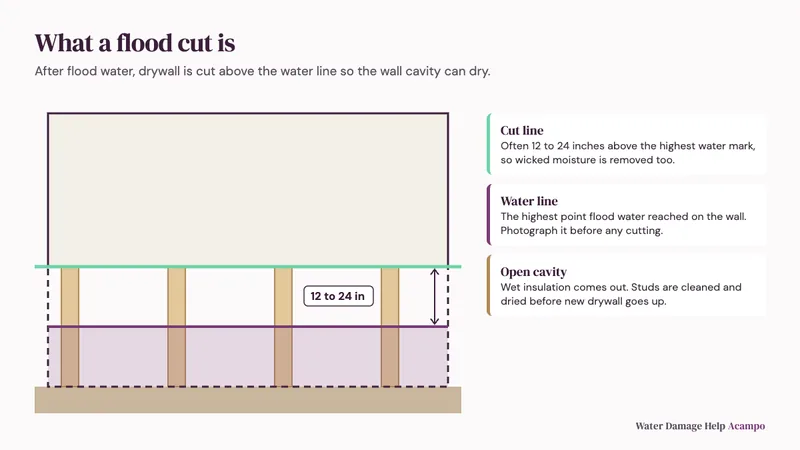
If your home has a concrete slab floor, the slab itself usually survives and the flooring on top is what fails. If it has a crawl space, ask the provider how that space will be inspected and dried. Carpet, cushion and laminate reached by flood water mostly come up either way.
Which belongings should you throw out after a flood?
Throw away porous things that flood water soaked and that cannot be washed and dried completely. Typical examples are carpet and cushion, mattresses, sofas, plush toys, wet insulation, the lowest drywall, plus any food or medicine the water reached. Snap a picture of every piece before it goes to the curb.
| Item type | Often cleaned | Often replaced |
|---|---|---|
| Floors | Sealed tile, bare concrete | Carpet, cushion, laminate |
| Walls | Wood or metal studs | Insulation, drywall under the cut |
| Furniture | Metal, glass, some hardwood | Particleboard, cushions |
| Household goods | Dishes, hard plastic, hand tools | Food, bedding, soft toys |
An appliance or electrical device that sat in the flood should be checked by a qualified technician before anyone plugs it in. Start a list with the item, its room, its approximate age and where it was bought, because your contents claim will be built from it. The contents cleaning and pack-out page covers what a provider can sort for you.
Use the photo checklist for what to capture. For an insured loss, the decision to keep or replace belongs to you and the adjuster.
How do you prevent mold after a flood?
Speed is the defense. EPA guidance sets a target of drying wet areas and belongings inside 24 to 48 hours and holding indoor humidity under 60 percent, ideally 30 to 50 percent. The CDC repeats that two-day target for flooded homes and urges removing soaked carpet and upholstery that cannot dry fast.
Lodi's winters are cool and wet, often with heavy ground fog, so cracking a window may add moisture rather than remove it. Ask how the provider will manage indoor humidity until the structure is dry.
- Leave wall cavities open until readings show the framing and subfloor have dried.
- Do not paint or caulk over mold; the EPA cautions against it.
- If contaminated water caused the damage, the EPA suggests hiring a professional used to such buildings.
- People with asthma, a mold allergy or a weakened immune system can have strong reactions, as the CDC explains.
If a patch has already appeared, the mold guide explains the next move.
Why does the Acampo area flood?
San Joaquin County, where Acampo sits, is described on Wikipedia as a very flat basin with an exceptionally high water table, prone to spring flooding as Sierra snowmelt runs off. Winter storms add more water, and the Mokelumne River flows near Lodi, a short distance south.
Wikipedia also notes that Camanche Dam, finished in 1963 below Pardee Dam, was built mainly to provide flood control for communities downstream. The Cosumnes River, the Mokelumne's largest tributary, joins it below Lodi.
Storm patterns matter as well. NOAA reports that a handful of atmospheric river events deliver roughly 30 to 50 percent of a year's precipitation across the western coastal states. NESDIS counted nine of them from late December 2022 into January 2023, with flooding in the Central Valley.
Across the county line, Wikipedia records a Cosumnes River levee break in January 2023 that flooded State Route 99 in Sacramento County, home to Galt. None of this proves that a particular address floods. For detail, see creek and river flooding and atmospheric river preparation.
How can you find out if an address is in a flood zone?
Search the address on FEMA's Flood Map Service Center to see the effective map, and try the state Department of Water Resources MyFloodRisk tool as a second look. Neither shows every street that has taken on water, so a clear result is a hint rather than a promise.
Your insurance agent can confirm the zone, which affects flood policy pricing and whether a lender requires one. Before rebuilding, ask the City of Lodi or San Joaquin County about drainage and permits.
The San Joaquin County page lists nearby communities this site serves, and the Sacramento County page covers Galt.
Will insurance pay for flood cleanup in California?
Usually not through a standard homeowners policy. The California Department of Insurance explains that homeowners policies exclude flood damage while covering other water damage, and that flood protection comes from its own policy. FEMA and Triple-I agree, pointing to the National Flood Insurance Program (NFIP) and a few private carriers.
| Water origin | Standard homeowners | Cover usually comes from |
|---|---|---|
| River, creek or storm runoff | Excluded | A stand-alone flood policy |
| Ground water or snowmelt | Not typically covered | Ask your agent |
| Sewer or drain backup | Not typically covered | A paid add-on |
| Burst pipe or appliance | Often covered | Your homeowners policy |
The NAIC lists ground water, rain runoff and snowmelt as typically uncovered. Triple-I adds that a sewer backup falls outside both a typical homeowners policy and flood insurance.
Timing matters too. A new flood policy starts 30 days after purchase, according to the Department of Insurance, with an exception for some borrowers whose federally regulated lender requires coverage. Buying one as a storm approaches rarely helps.
A Department of Insurance working group report put NFIP policies at under 5 percent of California homes in September 2019. Compare the two policy types on flood versus homeowners insurance.
What are California's deadlines for a flood claim?
Contact your insurer or agent once it is safe, and document everything before cleaning. Under California regulations, the insurer must acknowledge your claim in 15 calendar days. It then has 40 calendar days from receiving proof of loss to accept or deny.
- Report the loss and note the claim number.
- Photograph and film all walls and belongings, including the water mark, before touching anything.
- Limit further harm. Triple-I recommends reasonable protective steps while postponing major permanent repairs until an adjuster has inspected.
- Keep receipts and hold damaged items until the adjuster comes.
- Collect itemized bids that price materials line by line.
The timelines appear in Title 10 CCR section 2695.5 and section 2695.7. An insurer needing extra time must send written notice inside the 40 days and repeat it every 30 days.
After an insurer accepts, it owes payment inside 30 calendar days. A denial must be put in writing, and it must point you to the Department of Insurance for a review.
These rules bind insurers the department regulates. Its flood resources page states it does not regulate the NFIP, whose claims line is 1-800-638-6620. For everything else, the department's consumer hotline is 1-800-927-4357.
The water damage insurance claims page covers the wider process.
What questions should you put to a flood restoration provider?
Ask for the water category, the list of what is coming out and the reason, the method for judging dryness, and exactly what the written scope includes. Providers answer these differently, and this site cannot answer for any of them. Settle the details directly before work begins.
- Will walls and floors be photographed before anything is removed?
- What readings mark the structure as dry?
- Is the quote itemized, and what could move the total?
- Who talks to the insurer, and who pays any shortfall?
California's contractor board adds payment rules. The CSLB caps a home improvement down payment at $1,000 or 10 percent of the contract, whichever is lower, and advises paying only for work already finished. Verify any license through the CSLB Hire a Contractor page.
For more on vetting a provider, read how to choose a restoration company. If a shop or office flooded, see commercial water damage help.
Sources: Wikipedia, 2023 California floods.; Wikipedia, Lodi; Wikipedia, Mokelumne River; Wikipedia, San Joaquin County; NESDIS, atmospheric rivers hit the West Coast; NOAA Research, atmospheric rivers; CDC, mold and health; EPA, mold cleanup; EPA, mold and moisture guide; IICRC, S500; Ready.gov, floods; FEMA, no flood insurance FAQ; NAIC, homeowners insurance; Triple-I, settling claims; Triple-I, disaster coverage; CSLB, Home Improvement Contracts guide; 10 CCR 2695.7; 10 CCR 2695.5; CDI, Climate Insurance Working Group report; CDI, Flood Insurance Resources; CDI, Residential Property Claims Guide