The short version
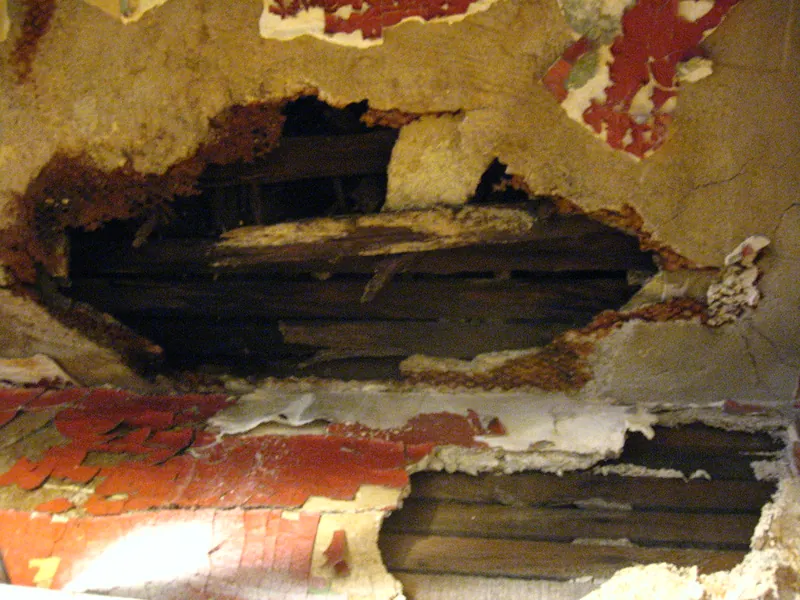
For drywall water damage repair in Acampo, the water type and how long the wall stayed wet decide whether it is saved. Firm board hit by a clean leak and dried early may stay. Sagging board, wet insulation or anything touched by sewage or flood water is usually removed.
Do you have to replace drywall if it gets wet?
Not always. Drywall that took a brief soaking from clean water and gets dry quickly can sometimes stay. Board that sags, crumbles, stays wet for days or touched sewage or flood water generally comes out, because the paper and gypsum core hold moisture and feed mold.
Three things decide the outcome: the kind of water, the time, and the extent. The IICRC S500 standard puts a supply line leak in its cleanest group and sewage or river overflow in its worst. A wall wet for a day behaves very differently from one wet for a week.
A provider uses a moisture meter to judge this, not the look of the wall. Surface paint can look perfect while the back of the board is still wet. Ask the team you reach how they will measure, and what reading tells them the wall is dry.
Which wall materials can stay and which have to come out?
Hard, dense materials tolerate water far better than paper-faced or soft ones. Drywall and plaster lie in the middle, and insulation and particleboard trim usually lose. The table below gives the usual call after a clean-water leak, though a real inspection can change it.
| Wall material | How it handles wetting | Usual call | What to check |
|---|---|---|---|
| Standard drywall | Paper face and gypsum core soak up water and soften | May dry in place if firm and caught early | Sagging, soft spots, brown stains, a musty smell |
| Plaster over lath | Denser, so water moves slowly, but it can loosen from the lath | Often dried, with loose areas replaced | Bulges, cracking, powdery surface |
| Fiberglass insulation | Holds water against the framing and loses loft | Wet batts are usually removed | Clumped or heavy batts behind the board |
| Wood studs and plates | Absorb moisture slowly and release it slowly too | Dried and checked with a meter | Dark staining, softness, a persistent smell |
| MDF trim and baseboard | Swells at the cut ends and does not shrink back | Frequently replaced | Puffy edges, flaking paint |
If you are unsure what is inside the wall, a moisture reading through the surface helps. See structural drying for how providers dry framing in place.
Where should I start when a wall is wet?
Stop the water, get people and belongings away from the wet area and begin airing the room. Do not poke holes or pull wallboard off yet. The order of the steps below keeps the damage from spreading and protects your claim.
- Shut off the source. Close the main valve or a fixture stop, or ask a plumber to fix the pipe or appliance line.
- Turn off power to any outlet or fixture on a wet wall at the breaker, if you can reach it dry.
- Photograph and film the wall from several angles, including the floor and ceiling around it.
- Move furniture and art away from the wall and lift hanging items out of reach.
- Open windows and run a dehumidifier, and put a fan in the room that does not blow directly on the wall.
- Call your insurer and a restoration provider, and ask whether they dry walls in place or open them.
The burst pipe page covers the shutoff in detail, and the photo checklist lists what to record.
How do I find water damage behind a wall?
Look for clues on the surface, then confirm with a meter. Stains, bubbling paint, a soft patch and a smell that returns after cleaning usually mean moisture inside. Water often travels far from its source, so the visible spot is rarely the whole problem.
Check the floor along the base of the wall for lifting boards or warped trim. Look at the ceiling in the room below if the leak came from upstairs. Cool, clammy spots on the surface suggest dampness behind it.
A moisture meter and a thermal camera are standard tools for tracing the extent, and some providers use them before cutting anything. If readings are high but nothing shows, a small inspection opening may be cut. See signs of water damage for a longer checklist, or ceiling water damage when the stain is overhead.
What is a flood cut, and when is cutting out wet drywall needed?
A flood cut removes the wet lower section of a wall at a straight line above the highest water mark. It exposes the cavity so studs and insulation can dry. It is used after floods and long leaks, and less often after a short clean-water wetting.
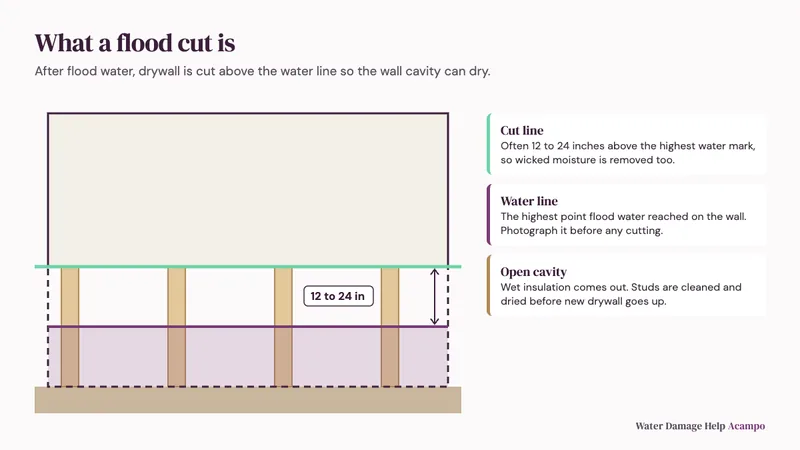
Cutting is also done when a wall will not dry any other way. Board that is soft, bulging or already moldy is removed instead of dried. The cut is often a bit higher than the visible stain, since moisture wicks upward through the paper.
Leave this to a provider where you can. Cutting into a wall near wiring or plumbing carries its own risks, and the cut line affects how easily the wall is rebuilt. Ask what will be removed, how the opening will be left to dry and who handles the new board and finishing.
Can I paint over water-stained drywall?
Not until the wall is completely dry, and not at all if mold is present. Paint laid over damp board seals the moisture in, which bubbles the finish and gives mold a place to grow. The EPA also says not to paint or caulk surfaces that already have mold on them.
Once a wall tests dry, a stain-blocking primer is the usual step before paint, since ordinary paint lets tannin and rust stains bleed through. Soft, crumbling or bulged board should be replaced, not painted.
A stain that comes back after painting means moisture is still arriving, so check roof flashing, plumbing and the AC drain line before another coat. See roof leak and storm damage if rain is the suspect.
What about wet insulation inside the wall?
Wet insulation usually has to come out. Fiberglass batts that stay soaked hold water against framing and lose their ability to insulate, and they dry far too slowly to be left in place. Closed-cell foam is a different case and can sometimes be dried.
Insulation is invisible behind sound drywall, which is why some providers open the lower wall and check it. If your wall has insulation and the board is soaked, assume the batts are wet too. If the water was dirty, the batts are discarded regardless.
The EPA's mold guidance sets the goal of getting wet materials dry in the first 24 to 48 hours. Insulation that cannot meet that goal is the usual reason a wall is opened.
What about swollen baseboards and trim?
Solid wood trim often dries and goes back on, while MDF and finger-jointed trim tend to swell and stay that way. Trim sits where water collects first, so it is often the first thing to show damage and the last thing to be checked.
Pull trim carefully if a provider asks you to, since removing it lets the wall base and floor edge dry. Number the pieces on the back so they can go back in order.
Check behind it before reattaching. A dark line along the bottom of the drywall or a musty smell means the wall still holds moisture. Reinstalling trim over a wet base hides the problem and slows drying.
Can I do drywall water damage repair myself in California?
Small, dry, clean-water patches can be a do-it-yourself job. California's contractor law also draws a line: CSLB says an unlicensed person may take on work totaling up to $1,000, labor and materials, only if no workers are hired and no permit is needed.
The EPA says a moldy area under about 10 square feet can usually be handled by the household. Larger areas, contaminated water and anything involving wiring or structure call for a provider.
If you hire someone, check their license on the CSLB license lookup and get the scope in writing. CSLB limits a home improvement down payment to $1,000 or 10 percent of the price, whichever is less. See choosing a restoration company for questions to ask.
What if mold shows on the wall?
Dry the area and treat it as a moisture problem first. Mold on drywall means the board stayed wet. Small spots on a hard surface can be cleaned, but mold that has gone into the porous paper face or backing usually means that board gets replaced.
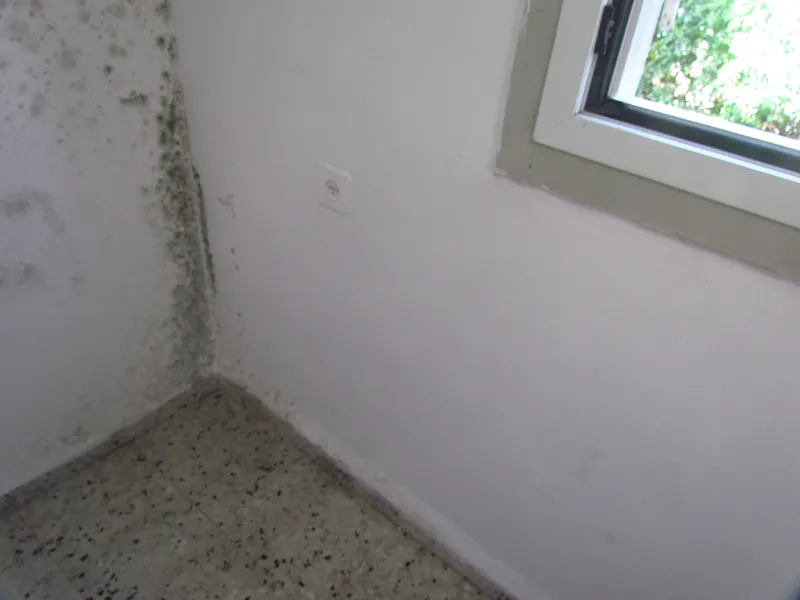

For hard surfaces the CDC suggests soap and water or a household cleaner. If you use bleach, keep it to 1 cup per gallon, and never mix it with ammonia. Gloves, goggles, boots and open windows are the CDC's other precautions.
The state's health department notes that California has no licensing rule for mold assessors or remediators, so ask a provider what experience they have. See mold after water damage for more.
Will insurance pay for drywall water damage?
Often, when the cause is a covered event such as a burst pipe, an appliance or a storm-damaged roof. California's insurance department says homeowners policies cover water damage but not flood. Policies differ, so read yours and ask your insurer what applies.
NAIC explains that ground water, rain runoff and snowmelt are typically excluded, and mold is often limited. Triple-I advises photographing damage, saving receipts and holding off on major permanent repairs until the adjuster has visited.
Two state deadlines are worth knowing under 10 CCR 2695.5 and 2695.7: 15 calendar days for the insurer to acknowledge a claim, then 40 from proof of claim to accept or deny it. The CDI hotline is 1-800-927-4357. See water damage insurance claims.
What does drywall water damage repair cost?
National guides put drywall restoration at about $1.50 to $3 per square foot. That figure comes from Fixr and Bob Vila and is an average across the country, not a quote. Actual prices depend on the area, the access and the finish needed.
Opening a wall, removing insulation, drying the cavity and replacing board, taping and paint are usually separate line items. Paint matching and texture often cost more than people expect. Providers set their own prices, so ask for a written estimate that lists each step.
The bigger cost driver is time. A wall dried early costs far less than one that grew mold. See water damage restoration cost and water damage repair for the wider picture.
Sources: IICRC water categories; EPA mold and moisture guide; EPA mold cleanup page; CDC mold and health page; CDPH mold FAQ; CSLB press release on the $1,000 limit; CSLB contract guide; CDI claims guide; Title 10 CCR sections 2695.5 and 2695.7; NAIC consumer page; Triple-I claims article; Fixr cost guide; Bob Vila cost guide.