The short version
For commercial water damage in Acampo, stop the source, check power safety, clear people and stock, photograph everything, then notify your insurer and the building owner. Not every provider takes large commercial jobs, so confirm directly, and read your policy to see what it covers.
What should a business owner do first when water gets in?
Stop the water, make the space safe, protect people and stock, record the damage, and then call the insurer and the building owner. That order keeps the loss from spreading while you wait for help. Commercial water damage in Acampo looks the same as anywhere else in the first few minutes.
- Close the shutoff. Turn the valve closest to the leak, or the main. Sprinklers are the exception: their maintenance contractor may have to shut that system off, so ring them first.
- Check the electricity. Ready.gov cautions against handling electrical equipment that is wet, or any equipment while you stand in water, and says to switch off power only where that can be done safely. When the panel sits in water, an electrician is the next call.
- Move people, then stock. Steer staff and customers off wet floors, then raise inventory and records where safe.
- Record first. Take photos and video of the source, the wet surfaces and the damaged goods.
- Notify the insurer and the landlord or owner. Triple-I tells policyholders to reach the agent or insurer right away and to postpone large permanent repairs until the adjuster has looked things over.
- Then ask a restoration provider whether it takes commercial jobs of your size.
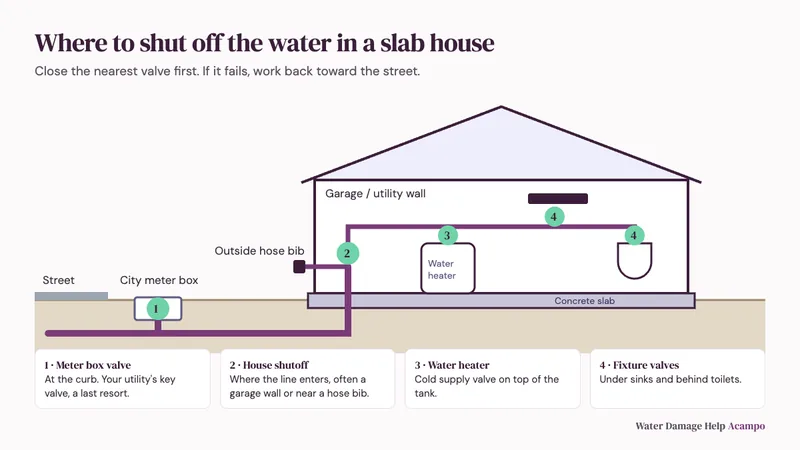
A failed supply line follows the path in the burst pipe guide, and the emergency water damage page lays out the whole sequence.
What makes a business loss harder than one in a house?
Water moves the same way in a store as in a kitchen, but a business adds people and systems around it. Responsibility may be split, operations may need to continue, and the floor area is bigger. Each of those shapes how work is planned and who signs off.
- Split responsibility. Tenant, owner and manager may each look after a piece of the building, with separate insurers behind them.
- Lost income. A closed day can hurt more than the repair bill, which pushes schedules toward the hours when the doors are shut.
- Access. Night and weekend jobs depend on keys, alarm codes and security being sorted out in advance.
- Shared structure. Water seeps into the next suite and the level beneath.
- Fire protection. A single sprinkler head can release a lot of water in a short time.
- Bigger equipment loads. A large floor needs many machines, and the circuits may not be there to run them.
Expect the first commercial conversation to dwell on access, occupants and scope more than a home call would.
Where does the water usually come from in each type of building?
Each kind of building tends to leak in its own ways, and the origin usually decides who gets the first phone call. Read the table as a loose guide, not a prediction for your property; a plumber, building engineer or insurer can speak to yours.
| Building | Common sources | Points of concern |
|---|---|---|
| Office | Roof units, restroom fixtures, supply lines, ceiling leaks | Paper files, server rooms, tenants below |
| Shop | Roof leaks, door runoff, supply lines, AC drain lines | Low shelves, flooring, display fixtures |
| Restaurant | Ice makers, dish machines, clogged floor drains, water lines | Food handling rules, cooking gear, dirty drain water |
| Church or school | Roof and gutter failures, restrooms, runoff | Big rooms, fixed service or class times |
| Apartment building | Unit plumbing, water heaters, appliances, roof | Many tenants, shared walls and ceilings, notices |
| Warehouse | Roof leaks, dock door runoff, floor drains, sprinklers | Pallets, concrete floors, tall ceilings |
Rental buildings overlap with several rows, and the renters and landlords guide covers the tenant side. For storm leaks through a roof, read roof leak storm damage, and for a single office suite see office water damage.
What if a fire sprinkler goes off in the building?
Sprinkler water arrives quickly, and it sometimes arrives by accident, with no fire at all. Triple-I names accidental discharge or overflow from sprinkler systems among the perils on standard policy forms. What your own business policy says is what counts.
Shutting the system down and putting it back in service belongs to the fire protection contractor, not to a restoration provider. Pumping and drying can start once the flow has stopped.
Say how it started when you report it, whether a fault, a fire or a damaged pipe, since the cause shapes the claim. Damage from a fire is its own subject and is not covered here.
Does business insurance in California cover water damage?
It might, but the wording of the policy has the final say. Commercial forms differ from homeowners forms in coverage, exclusions and the duties placed on you once a loss occurs. Check your own, or ask the agent, rather than assume.
A February 2025 California Department of Insurance release states that flood, mudslide and debris flow are typically excluded from commercial as well as homeowners policies, unless a recent wildfire or another covered peril is behind them. Triple-I notes that sewer backup is usually a separate add-on, and that neglected maintenance is not covered.
Ask too whether income is replaced while you are shut, and how stock and contents are treated. Bring up flood on its own, because water from outdoors is a different loss from a plumbing leak.
Flood cover is slow to begin. The CDI says a flood policy starts 30 days after purchase, except for certain borrowers. The habits in the insurance claims guide carry over: photograph first, save receipts, and keep damaged goods for the adjuster.
Who is responsible, the tenant or the owner?
Start with the lease and the origin of the water, and tell the owner early. Responsibility is not assigned automatically: a tenant does not inherit a leak inside a wall, and an owner is not liable for a tenant's inventory by default.
Tell the landlord or manager in writing the day you find out, and keep a copy of the message. Then settle who arranges the drying, who deals with contents and whose insurer is on each side. A manager of many units should keep a single log across all of them.
California's habitability provisions, Health and Safety Code 17920.3 and Civil Code 1941.1, address dwellings. They say nothing about a commercial lease, and only a lawyer can explain those terms.
Will a restoration provider take a big commercial job?
Do not assume so. Commercial work is accepted by some providers and declined by others, and each draws its own line on size and services. This site cannot tell you beforehand who will say yes to a building.
Describe how big the wet area is, what kind of property it is and where the water came from. Ask if work can run after hours and how it fits around people using the space. If the answer is no, ask whom they would suggest.
The guide to choosing a restoration company lists screening questions and warning signs. Nothing here promises that any provider is available or takes commercial work.
How is a commercial building dried out?
The approach is a house's, enlarged: cut off the source, take out standing water, remove what is beyond saving, run dehumidifiers and air movers, and follow progress with readings. The EPA wants wet areas dry in 24 to 48 hours to hold off mold, so the timing is unchanged.
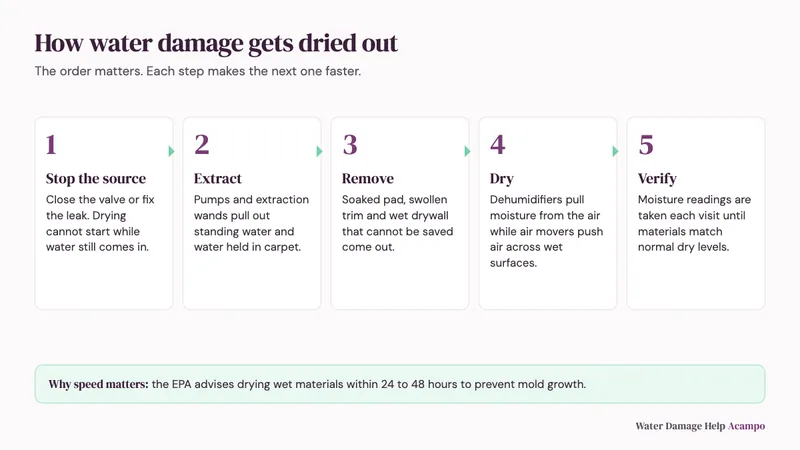
Extra machines are needed across a wide floor, and the building may not have spare circuits for them. Concrete and masonry can stay damp longer than they look, so ask for the readings at every visit.
The structural drying page explains how moisture is tracked, and water mitigation covers the early work.
Mold in a workplace has its own regulator. The California Department of Public Health says workplace mold and moisture rules are enforced by Cal/OSHA, and that California has no licensing regime for mold remediators.
What if the water comes from a storm, a creek or a sewer?
Assume it is dirty until an expert says it is not. Under IICRC S500, sewage, rising river and stream water, and surface water from outdoors all count as Category 3. The EPA recommends a professional with experience in contaminated-water damage.
Where floor drains exist, as in a restaurant, a backup can push dirty water into occupied rooms, so keep people and food areas well away. Sewage backup cleanup and flood cleanup show how those jobs differ.
The Central Valley has seen how large this can get. NESDIS reports that nine atmospheric rivers in late December 2022 and January 2023 caused flooding in the Central Valley. Wikipedia says a Cosumnes River levee broke that January in Sacramento County, flooding State Route 99.
San Joaquin County is a flat basin with an exceptionally high water table, and it tends to flood in spring with Sierra snowmelt. The creek and river flooding page covers that risk for this area.
How can a business prepare ahead of winter storms?
Write the shutoff locations, call list and first-to-save items on one sheet, and hand copies to the people who need them. That sheet buys back the first, most expensive minutes of a loss. Ready.gov offers Ready Business toolkits for inland flooding, power outages, earthquakes, hurricanes and severe wind.
- Shutoffs. Mark the main valve, each suite's valve and the water heater supply, then label and photograph them.
- Sprinkler contact. Write down who maintains the system and how to reach them.
- Call list. Policy numbers plus the plumber, electrician, owner, manager, insurer and agent.
- Keys and codes. Record who holds each key and alarm code.
- Lift-first list. Name which files, machines and goods go up first, and shelve them off the floor.
- Winter damp. Wikipedia reports that Stockton gets nearly 95 percent of its rain from October through April, so check roofs and gutters before then.
NOAA says that in the west coast states about 30 to 50 percent of annual precipitation arrives in just a few atmospheric river events. The atmospheric river prep page and the prevention guide list common leak points to check.
Where can a property manager look next?
Pick the page that fits where the water came from. If you manage several buildings, the water damage guides work as a set of checklists, and the glossary decodes work-order terms.
The service areas page lists the communities this site covers, among them Lodi, Woodbridge and Lockeford. Restoration teams differ in what they take on, so confirm directly.
Sources: Ready.gov flood page; Ready.gov Ready Business; EPA mold and moisture guide; EPA mold cleanup page; IICRC S500 overview; Triple-I on settling claims; Triple-I on covered disasters; California Department of Insurance press release, February 2025; California Department of Insurance flood resources; CDPH mold FAQ; NOAA NESDIS, Atmospheric Rivers Hit West Coast; NOAA Research on atmospheric rivers; Wikipedia, 2023 California floods; Wikipedia, San Joaquin County; Wikipedia, Stockton.