The short version
When choosing a restoration company near Acampo, insist on a written, itemized estimate, read every form first, ask to see moisture readings and look up the CSLB license. California limits a down payment to $1,000 or 10 percent. This site ranks none of them.
What should I check before choosing a restoration company near Acampo?
Run six checks before you sign anything: the scope of work, an itemized written estimate, how drying will be tracked, what the forms say, how the work meets your insurance claim and which California license covers the job. A provider that answers all six plainly, on paper, is a workable choice.
- Scope. Which rooms, what comes out and what is dried in place.
- Estimate. Triple-I advises collecting bids in writing, with materials and prices itemized.
- Tracking. Moisture readings logged at every visit, open for you to see.
- Paperwork. Every form read and explained before you sign, not after.
- Insurance. The claim still runs through your own insurer.
- License. The state contractor board, CSLB, sets the rules, covered below.
You can make these calls while someone else turns off the water, and none of them slows the dry-out. Steps to take at the property are in emergency water damage restoration.
Can anyone name the top restoration company near Acampo?
Not honestly, and this site will not try. It holds no opinion on which company is better. There are no rankings, scores or endorsements here, and no company pays to appear on a list or to be picked first.
Online roundups of top local companies mix paid placement with averaged stars, and neither predicts what happens in your house. Acampo has only 334 residents, so a crew may drive in from Lodi or farther. The dependable test is paperwork and straight answers, and a provider reached through this site should meet the bar that one you found alone would.
Which questions should I ask on the first phone call?
Treat the table as a call script and write down each answer. The questions cover how the work gets done and how it gets billed. A solid provider takes them in stride, because any customer could reasonably ask the same things before agreeing to a job.
| Question | Why it matters | What a clear answer sounds like |
|---|---|---|
| Will the estimate be itemized and written? | A single total hides what each piece costs | Yes, with equipment, labor and materials each on their own line |
| What will be torn out, and what will you try to save? | Demolition drives both cost and rebuild work | A plan for each room, with a reason behind every removal |
| How will drying be monitored? | Readings show whether materials are really drying | Numbers recorded each visit and shared on request |
| Which water category is this? | The IICRC S500 standard handles clean and contaminated water differently | A category tied to the source, with a matching plan |
| May I read the paperwork first? | Forms can carry payment and insurance terms | Yes, with a walk through each section |
| Who holds the contractor license for this job? | California licenses contractors by classification | A named holder whose number you can look up |
Note the date and who answered. If the invoice later contradicts a phone answer, that note carries weight.
What license does a California restoration provider need?
California licenses contractors through CSLB, which says it regulates about 285,000 of them. A job worth more than $1,000, counting all labor and materials, generally needs a license. The threshold rose from $500 on January 1, 2025, under Assembly Bill 2622, so older web pages may show the earlier figure.
CSLB's press release adds that an unlicensed person may do jobs under $1,000 only if they hire no workers and no permit is needed. Unlicensed contracting can bring fines up to $15,000 and up to six months in jail. CSLB's contractor page links an online tool for checking a license, so look up the license holder by name.
Mold is different. The California Department of Public Health says no state license exists for mold assessors or remediators, and national groups such as IICRC offer certifications that CDPH does not endorse. If mold turns up, mold after water damage explains the next steps.
Ask the provider to state in writing which licenses apply to the scope quoted, then verify what you can with CSLB.
What am I signing, and what are my payment rights?
Most often a work authorization, and sometimes a second form that governs how your insurer pays. Read each page even with water on the floor, and ask what any unclear clause obliges you to do. California also gives home improvement customers a few protections worth knowing.
CSLB's consumer guide, Terms of Agreement, caps a down payment at the lesser of $1,000 or 10 percent of the contract price. It says to pay only as work is completed and to record changes in a written change order. Buyers get three business days to cancel, or five at age 65 or older.
An emergency service and repair contract you asked for on short notice is an exception, and the cancellation right ends once you sign and work starts.
- Scope. It should match what you discussed on the phone.
- Payment terms. Who receives the bill, the due dates and the plan if your insurer pays a smaller amount.
- Insurance language. Some forms let a provider deal directly with your insurer, so ask which of your rights you share.
- Blank lines. Never sign a form someone could finish after you leave.
- Your copy. Leave with a signed copy or photos of every page.
A provider who will not let you read first has shown how the job may go. For what a clause means in law, ask an attorney or your insurance agent.
How do I spot a storm chaser or a pushy crew?
A storm chaser is a crew that turns up after a big storm and presses for quick signatures. Common signs include a knock at the door, a deadline to sign, no verifiable local address and no written scope. Treat them like any other bidder and run the usual checks before anything is signed.
Demand for dry-out help climbs after a major event. NOAA's NESDIS reports nine atmospheric rivers hit California from late December 2022 into January 2023, with flooding reaching the Central Valley, and surges like that attract out-of-area crews. A local name proves nothing, and the paperwork does.
The California Department of Insurance cautions homeowners about contractors who urge large temporary repairs. For storm background, see atmospheric river prep and flood cleanup.
Why should the estimate be itemized and in writing?
An itemized estimate lets you compare two quotes and audit the final invoice, which is impossible with a single number. Triple-I advises written bids that spell out materials and prices, whether you or an insurer pays. That document becomes the baseline for every later conversation about the job.
A usable estimate puts equipment, labor, materials and hauling on separate lines. One total, or one entry reading water mitigation, gives you nothing to check. Scope often grows after walls open, so ask how extra work gets approved, since hearing about a new charge in advance beats discovering it on the last page.
For ballpark ranges, see the restoration cost guide. A real price needs someone to see the damage.
What should daily drying readings show?
Every visit's numbers should fall for each wet material. A meter reading goes into each wall, floor and framing member, gets logged and is measured against the dry level for that material. A reading that stops dropping means the drying plan needs a change, and you can ask what the change will be.
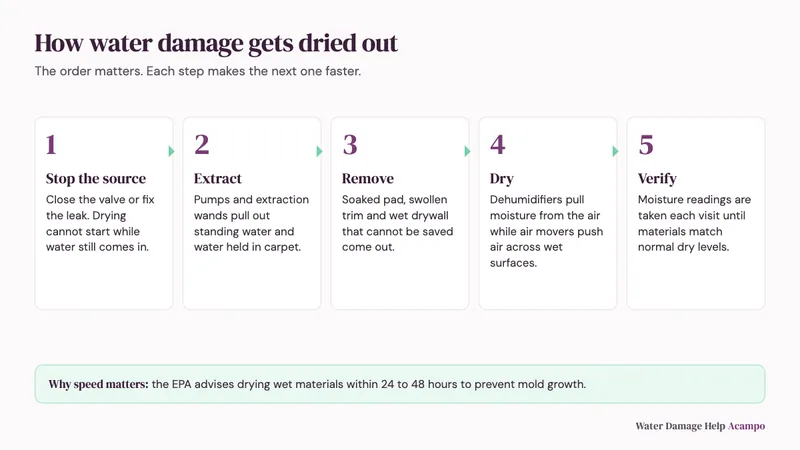
Request the log. A provider that keeps readings can usually hand them over, and the log supports the equipment days on the bill, so billed days with no readings behind them are fair to question. Water mitigation lists the sequence, and structural drying explains how moisture gets tracked.
Which warning signs mean I should call someone else?
Watch for pressure to sign at once, no written estimate, fuzzy billing and a reluctance to show readings. Any one of them deserves a pause. Two or more together are reason to call a different provider instead of hoping the pattern changes.
- A rush to sign. Protecting the property comes first, and a few minutes for reading is reasonable.
- No estimate on paper, or a vow to name the price afterward.
- A single lump sum on the invoice.
- A refusal to share readings or work photos.
- A large deposit with no account of what it pays for, when CSLB's limit is $1,000 or 10 percent, whichever is less.
- A push to discard damaged items early. Triple-I advises keeping them until the adjuster visits.
- Advice to skip your insurer.
Good signs are the opposite: a written scope, itemized prices, logged readings and calm answers to every question.
What are my options if the invoice looks wrong?
Start by requesting the itemized invoice and the drying log, lay both beside the estimate and send pointed questions in writing. When an insurer is paying, involve the adjuster as well, since the claim file should show what was done. These steps work best in order.
- Request the itemized invoice, readings and photos.
- Compare it with the written estimate. Mark each charge that is new, higher or unexplained.
- Get the provider's explanation in writing and save every message.
- Tell the adjuster if a claim is open, and send the invoice and readings.
- Check for an appraisal clause. Triple-I says many policies allow one: each side picks an appraiser, they pick an umpire, and any two decide.
- Contact CSLB about a contractor problem at 800-321-CSLB (2752).
Disputes with an insurer go to the California Department of Insurance, which takes complaints at 1-800-927-4357. Triple-I warns that a public adjuster may charge up to 15 percent of a settlement, so check any candidate with the BBB and the state insurance department. The full process is laid out in the insurance claims guide.
Does my insurance company affect who I can hire?
It shapes your first moves more than your pick of provider. Triple-I's advice is to call your agent or insurer promptly, limit further damage and wait on major permanent repairs until the adjuster has assessed the loss. That order protects both the claim and the house.
Photograph the damage before work begins and save each receipt, since the Department of Insurance says reasonable protection costs can be reimbursed with receipts. A few policies point you to particular vendors, so ask your insurer instead of guessing.
Water from outside raises a separate issue, since FEMA says most homeowners insurance does not cover flooding. Read flood versus homeowners insurance before approving a large scope.
How is water mitigation different from restoration?
Mitigation limits how far the damage spreads: removing standing water, pulling materials that cannot be saved, drying the structure and recording readings. Restoration or repair rebuilds walls, floors and finishes afterward. The terms are used loosely, and some companies do both while others do only one.
The IICRC S500 standard says finding and fixing the source of the water is the owner's job rather than the restorer's. Ask what the estimate covers, and whether a plumber is needed. Water damage repair explains the rebuild side, and contents cleaning covers belongings.
How does a call from this site work?
A call or request here reaches a local water damage restoration team that serves your area. The site has no say over prices. The team supplies the scope and the terms, and you can decide whether to accept them.
For the setup in more detail, read about this site and the editorial policy. The checklist above fits any provider however you found them, and phoning someone else is your right.
Sources: CSLB press release 24-21; CSLB, Terms of Agreement guide; CDPH, mold FAQ; California Department of Insurance, Residential Property Claims Guide; CDI, file a complaint; Triple-I, settling claims; FEMA, flood insurance FAQ; NOAA NESDIS, atmospheric rivers; IICRC S500; Acampo, California (2020 census).