The short version
No local survey exists, so water damage restoration cost in Acampo is best judged against national data: Fixr (2025) averages about $3,000 across a $1,200 to $5,000 band. Dirtier water, wider spread, soaked materials and longer drying push it up. Get itemized written bids and verify each license with CSLB.
What does water damage restoration cost around Acampo?
Nobody publishes an Acampo price list, so the sensible yardstick is a national one. Fixr reports an average of $3,000 inside a $1,200 to $5,000 band. Bob Vila relays Angi and HomeAdvisor data of $1,305 to $5,707, averaging $3,455. Neither is an Acampo number.
Use these as a sanity check on any water damage restoration cost you are quoted near Acampo, never as a quote of their own. Each restoration team sets its own rates, and this site sets none. With 334 residents counted in 2020, Acampo is too small for a local survey.
The band runs wide since the same label fits a lightly damp bath floor or a living room under standing water. How contaminated the water was, how much floor it reached and what it soaked explain most of the gap.
What does pulling out standing water cost per square foot?
Fixr's national survey shows extraction between $3.75 and $7.50 per square foot, rising with contamination because crews need more protection, disposal and tear-out. A bid in Lodi or Galt could come in higher or lower. Think of the figures as a starting reference.
Under the IICRC S500 standard, a water category describes how contaminated the water is. It says nothing about how much water there is.
| Water type | Where it comes from | Fixr national rate per sq ft |
|---|---|---|
| Clean (IICRC Category 1) | A failed supply hose or pipe | $3.75 to $4.25 |
| Gray (Category 2) | Laundry or dish machine discharge, a toilet overflow carrying no waste | $4.10 to $6.50 |
| Black (Category 3) | Raw sewage, a rising river or stream, runoff from outdoors | $7 to $7.50 |
Fixr, 2025, national averages. Local bids differ.
A clean-water break costs least. For sewage, the EPA recommends a professional with experience in contaminated-water jobs. See sewage backup cleanup and water removal for how those visits go.
How are damage classes different from water categories?
A category tells you how dirty the water was, while a class tells you how much of the building soaked it up. One burst supply line stays Category 1 whether it wets a hallway or an entire floor. Your estimate moves on both scales at once.
Fixr quotes a flat national range for each class. A higher number signals that water reached farther and more material took it in.
| Class of loss | Fixr national flat range |
|---|---|
| Class 1, least absorption | $150 to $400 |
| Class 2, a room or more of wet material | $500 to $1,000 |
| Class 3, water from above or throughout | $1,000 to $3,000 |
Fixr, 2025. Flat project ranges, not per square foot.
Climbing a class means more soaked material, more drying gear and extra days of monitoring. A shutoff valve closed in the first minutes is the cheapest repair you will make.
What pushes a repair bill up or down?
Seven factors account for most of the difference between two invoices, and the first day of the loss fixes most of them. Providers weight them in their own way, so ask which ones drive your number. Wider spread and more soaked material nearly always mean a bigger bill.
- Contamination. Clean, gray and black water sit at different rates in the first table.
- Reach. Water that slips under a wall plate or into the adjoining room widens the drying zone.
- Floor area. National sources price both extraction and rebuild by the square foot.
- Tear-out. Pad, drywall and trim past saving are removed and replaced, a separate line from drying.
- Equipment time. Air movers and dehumidifiers stay until moisture readings come back dry.
- Belongings. Furniture, boxes and electronics in the wet zone must be moved or handled.
- Hard-to-reach spots. A leak inside a finished wall or above a ceiling takes more labor than an open floor. See ceiling water damage repair.
What does rebuilding cost by material?
In Fixr's national tables, drywall is the lowest per-square-foot repair, and plaster and hardwood top the list. Carpet and mold work sit between them. Any bid near Acampo may fall above or below a line, so lean on the table only for orientation.
| Material | Fixr national, per sq ft |
|---|---|
| Drywall panels | $1.50 to $3 |
| Wall-to-wall carpet | $4.75 to $10.50 |
| Plaster walls | $6.25 to $18.75 |
| Hardwood boards | $10 to $15 |
| Mold treatment | $4.75 to $5.50 |
Fixr, 2025.
Bob Vila quotes some work per project instead: $350 to $1,250 for a ceiling, $200 to $500 for floors, and $1.50 to $3 per square foot for drywall. Both sources agree on drywall. They are separate surveys, so the other lines do not line up.
For individual materials, read drywall water damage repair and water damaged floor repair.
Would river or flood water raise the price near Acampo?
It would, since water arriving from outdoors falls in Category 3 under the IICRC S500, and Fixr prices extraction in that category at $7 to $7.50 per square foot before anything else. Rebuild is extra. Flood totals are not published because each event differs.
San Joaquin County is a flat basin with an exceptionally high water table, and its Wikipedia entry says it tends to flood in spring when Sierra snowmelt runs off. Upstream of Lodi on the Mokelumne River, Camanche Dam was built mainly for flood control.
Drywall and insulation that drew up dirty water are usually cut out rather than dried. Read flood cleanup and river and creek flooding near Acampo. Standard homeowners policies leave flood out, as the insurance section below explains.
What does each kind of damage cost?
Every cause lands on a different row of the national figures. This list ties common causes to numbers quoted above, so none of it is a price for your house. Find the cause that matches yours and read the row beside it.
- Burst or frozen pipe. Typically Category 1, so the clean-water extraction rate applies, plus drying and any walls opened. The pipe repair itself comes from your plumber. See burst pipe water damage.
- Ceiling damage. Bob Vila gives $350 to $1,250. Whatever leaked from above is repaired on its own ticket.
- Sewage backup. Category 3 water, so $7 to $7.50 per square foot is where the estimate starts.
- Water heater or appliance leak. Usually clean or gray water, priced by category and class. See water heater leak.
- Mold. Fixr lists $4.75 to $5.50 per square foot, while Bob Vila lists removal at $1,100 to $3,400, averaging $2,200. The mold guide is at mold after water damage.
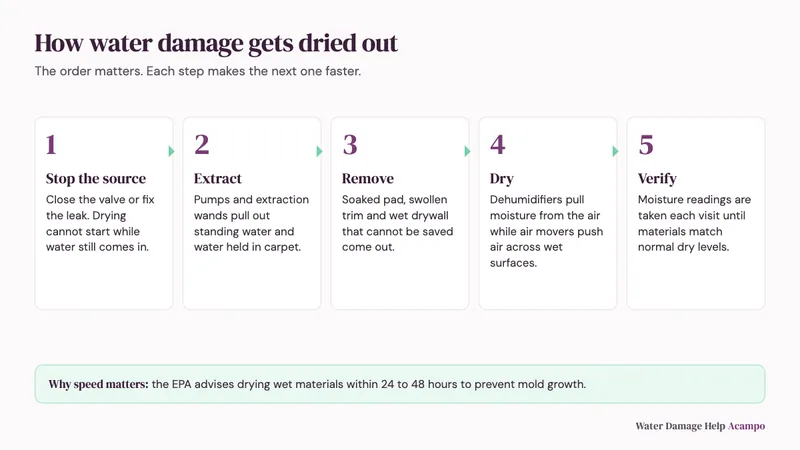
Mold is the one cost that prompt action often removes. Per the EPA, growth is prevented by drying wet areas and belongings inside 24 to 48 hours.
Why do drying and rebuilding arrive as two bills?
They are different trades with different schedules, and often different companies. Mitigation holds the damage in place through extraction, demolition of ruined material and drying. Rebuild installs new drywall, paint, flooring and trim, normally once the structure tests dry and the moisture readings have been recorded.
Mitigation ends when moisture readings show dry materials, and a separate contractor frequently handles the rebuild. Find out if a quote prices one phase or both, and read the water mitigation page for what the first phase involves.
A low drying quote with no rebuild line is not automatically a bargain or a trap. It means only half the job is priced.
How do I check a water damage estimate?
Work down the page line by line and hunt for four items: equipment days, square footage, removed materials and proof. Good paperwork explains what each charge buys. Anything murky should be explained by the provider before you put a signature on it.
- Equipment days. Each air mover and dehumidifier should show how long it ran.
- Area. Extraction and tear-out lines should name the square footage and the rate.
- Removed items. Pad, drywall, baseboard and insulation deserve their own lines.
- Proof. Request the photos and moisture readings that support the drying days.
- Rebuild. Mark which lines are drying and which are replacement.
The Insurance Information Institute (Triple-I) advises collecting written bids that itemize materials and prices. Our glossary decodes invoice terms.
How do California contractor rules apply to a bid?
The Contractors State License Board (CSLB) publishes licensing and payment rules that make a handy test for any bid. Verify the license of whoever does repair or rebuild work, and tie payments to finished work. Restoration teams differ, so confirm every point directly.
- License limit. CSLB reports that Assembly Bill 2622 lifted the no-license ceiling from $500 to $1,000 on January 1, 2025. It counts labor and materials together and applies only when no workers are hired and no permit is needed.
- Deposit. In its consumer guide, CSLB caps a home improvement deposit at the smaller of $1,000 or 10 percent of the contract price.
- Progress payments. CSLB says to pay only as work is completed, with any change set down in a written change order.
- Cancelling. The same guide lists three business days to cancel in many cases, except for emergency repairs you request on short notice.
CSLB takes calls at 800-321-2752, and its website at cslb.ca.gov has a license lookup. For more questions to ask, see choosing a restoration company.
How much of the bill does insurance cover?
That depends on your policy and on where the water came from. Sudden plumbing and appliance leaks are commonly covered, while flood and sewer backup typically need their own policy. Weigh the estimate against your deductible, and ask your agent before deciding to file.
- Commonly covered: sudden overflow or discharge from pipes, a cooling system or an appliance, plus frozen plumbing, per Triple-I. The NAIC adds that a leaking roof is typically covered.
- Left out of standard policies: flood. The California Department of Insurance states that flood damage is not covered by homeowners policies, though other water damage is.
- Often an add-on: sewer backup. Mold and neglected maintenance are frequently excluded.
For perspective, the Triple-I fact sheet reports $15,400 as the average claim for water damage and freezing, across 2019 to 2023. Yours depends on your own loss and policy. The insurance claims guide walks through filing.
What are the cheapest first moves after a leak?
Stop the water, then get wet materials dry inside the 24 to 48 hours the EPA cites for preventing mold. Most savings are won on the first day, so the order of your first moves matters, and the steps below are listed in that order.
- Cut the supply. Shut the main or the nearest fixture valve, because flowing water pushes a loss into a higher class.
- Clear what you can. Lift furniture and boxes out of the wet area when it is safe.
- Phone early. A restoration provider may start drying while you sort out the plumber and insurer.
- Document it. Take photos, video and receipts, and keep damaged items until the adjuster looks, as Triple-I advises.
- Watch humidity. The EPA suggests indoor levels under 60 percent, ideally 30 to 50 percent.
When you are ready, the contact page gives you a way to reach a local water damage restoration team. Each one works differently, so confirm specifics yourself.
Sources: Fixr cost page (Jan. 31, 2025 update); Bob Vila cost article (May 30, 2023 update); IICRC S500; CSLB press release on AB 2622; CSLB home improvement contract guide; CDI residential property claims guide; Triple-I claim statistics; Triple-I advice on settling claims; Triple-I coverage explainer; NAIC consumer page; EPA brief mold guide; EPA mold cleanup page; Wikipedia, San Joaquin County; Wikipedia, Mokelumne River; Wikipedia, Acampo.