The short version
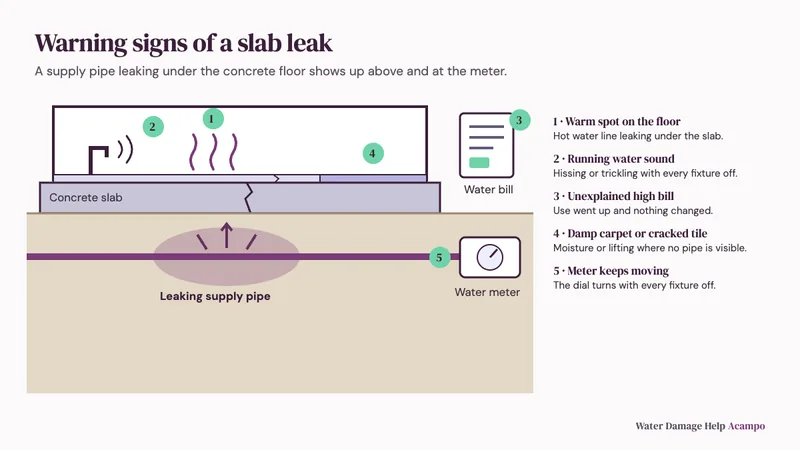
In Acampo a slab leak means a water line has failed beneath the floor. Clues include one warm patch, a faint rushing noise, a rising bill and a meter dial that keeps turning when nothing runs. Close the water supply, bring in a plumber to pinpoint the break, then arrange drying for wet flooring and walls.
How do I know if I have a slab leak in Acampo?
A slab leak is a break in a water line that runs under or through a concrete floor. You cannot see the pipe, so you notice side effects: a warm patch of floor, a hiss when everything is off, a bill that climbs, or flooring that turns damp. If your house sits on a slab, learn these signs.
No source this site uses says what kind of foundation homes in Acampo have, so treat this page as a checklist. If your house has a crawl space or raised floor instead, the same signs apply to the pipes beneath it. One sign alone has many possible causes. Two or three together point to the floor.
| Sign | What it looks or sounds like | Harmless look-alikes |
|---|---|---|
| Warm floor patch | One spot of tile, wood or carpet feels warmer than the rest | Afternoon sun, a heating vent, a hot water line in a wall |
| Water sound | A soft trickle or hiss while every tap is closed | A toilet that keeps topping off, a dripping shutoff valve |
| Bill creep | Usage climbs although nobody new lives there | Lawn watering, a new appliance, extra guests |
| Damp floor | Wet carpet edges, cupped planks, loose tile, a musty smell | A roof, window or appliance leak nearby |
| Meter movement | The dial keeps moving with all fixtures idle | A leaking sprinkler line or hose bib |
Is it a pipe leak or ground water coming up through the floor?
That question matters in this part of California. San Joaquin County sits in a very flat, low basin with an exceptionally high water table, and the county tends to flood in spring with Sierra snowmelt runoff, according to Wikipedia's county article.
Seepage from the ground behaves differently from a pressurized pipe. It tends to track with wet weather and spring runoff, not with how much water your household uses. A pipe leak keeps going in a dry week and shows on the meter.
- Meter moves with fixtures off: points to a pipe.
- Floor is wet only after heavy rain or a high-water period: points to ground water or drainage.
- Warm spot or hissing sound: points to a hot water line.
The insurance side differs too. The NAIC says damage from a home's plumbing is typically covered, while ground water, rain runoff and snowmelt are not. If river water is involved, see creek and river flooding.
How do I use the water meter to test for a slab leak?
Turn off everything that draws water and watch the meter. EPA WaterSense advises that any change in the reading while no water is in use probably signals a leak. This check cannot find the break. It only shows whether you need a plumber.
- Stop all use. Make sure the dishwasher, washer, ice maker and irrigation timers are idle and nobody flushes.
- Find the meter box near the street and note the reading or photograph it.
- Wait, then look again. Any change with everything off means water is escaping.
- Close the house shutoff and check once more. If the dial halts, the leak lies in the lines inside the house. If it keeps turning, the break is on the stretch between meter and house.
- Rule out toilets by dropping a little food coloring in each tank, a common false alarm.
Small leaks add up. By the EPA's count, a single drip each second can lose over 3,000 gallons in a year, while an irrigation leak the width of a dime can lose about 6,300 gallons every month. See high water bill leaks for the billing side.
What are the first steps if I suspect a slab leak?
Turn off the supply where it enters the house, phone a plumber who offers leak detection, and keep the floors protected until they arrive. The pipe is the plumber's job, and soaked materials belong to a restoration provider. You need both, with the pipe first.
- Shut the main valve. It is often in a garage, a utility closet, a crawl space entry or the meter box.
- Lift belongings off damp floors and set furniture legs on blocks or foil.
- Document the problem: photos of wet spots, the meter dial and recent bills.
- Phone a plumber and mention that the meter turns while nothing is on.
- Tell your insurer soon. The California Department of Insurance expects owners to track down a leak and stop it right away.
- Ask a provider about drying when floors or walls are already soaked; the water mitigation page describes that work.
Even after the supply is shut off, damp materials still need to dry. The signs of water damage guide lists other spots worth checking.
Who finds the leak, and who fixes the floor?
Locating and fixing the line falls to a plumber. Detection is a plumbing skill, typically using acoustic listening tools or pressure tests that shrink the search to a single spot. Restoration providers do not repair pipes, and IICRC S500 treats stopping the water source as the property owner's duty.
- Plumber: verifies the leak, pinpoints it and mends or swaps the line.
- Restoration provider: pulls out standing water and soaked materials, dries the building and records moisture readings.
- Flooring or drywall contractor: does the rebuild once readings come back dry.
- Insurer: determines what the policy pays after an adjuster's visit.
Check each contractor's license with the Contractors State License Board before work starts. CSLB says a down payment is capped at the lesser of $1,000 or 10 percent of the contract price, and that you should pay only as work is completed. Restoration teams differ, so confirm each team's scope directly.
Should the plumber patch the leak or reroute the pipe?
It depends on the pipe, its age and how many times it has failed. A patch opens the floor at the break and repairs that stretch. A reroute abandons the line under the floor and runs a new one through walls or the attic. Ask the plumber to explain both options in writing.
| Option | What it involves | Trade-off to ask about |
|---|---|---|
| Spot patch | Open the floor above the break and repair that section | Smaller job now, but weak spots elsewhere on the line remain |
| Reroute | Install a new line outside the floor and cap the old one | Less cutting of concrete, more opening and patching of walls |
Do not agree to a price by phone before someone has diagnosed the leak. Get a written scope from at least two plumbers and ask what happens to the floor finish. This site does not quote prices because they vary by house and provider.
What does a slow leak under the floor do to flooring and walls?
Water comes up through joints and cracks, wets the underside of flooring first and then wicks into the base of walls. Because it stays hidden, the damage is often wider than the visible stain. Different materials react in different ways.
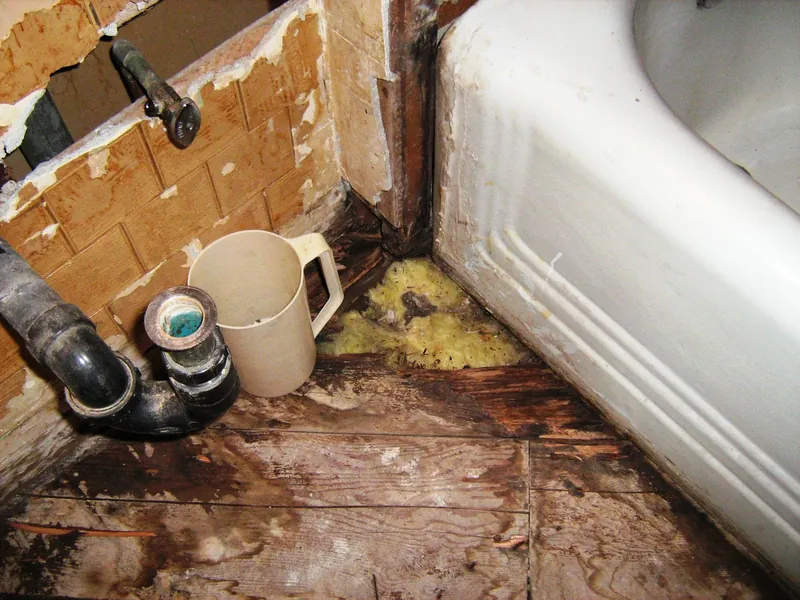

- Carpet and pad: soak up water, and the pad normally gets replaced; see wet carpet drying.
- Hardwood and laminate: warp and lift, and rarely dry well where they lie; water-damaged floor repair has details.
- Tile: may crack or come loose if the bed underneath stays damp.
- Baseboards and drywall: wick moisture upward, so the lower section is often cut out.
- Cabinet bases: particleboard swells and rarely recovers.
A provider should read moisture in the floor, the covering and the lower wall, then explain what the numbers mean.
How is a wet floor dried after the leak is stopped?
Drying starts once the plumber has stopped the water. The provider pulls up wet coverings and pad, opens the lower wall when needed, and runs air movers and dehumidifiers. Concrete holds water and releases it slowly, so readings are taken across several visits until they match dry reference points.
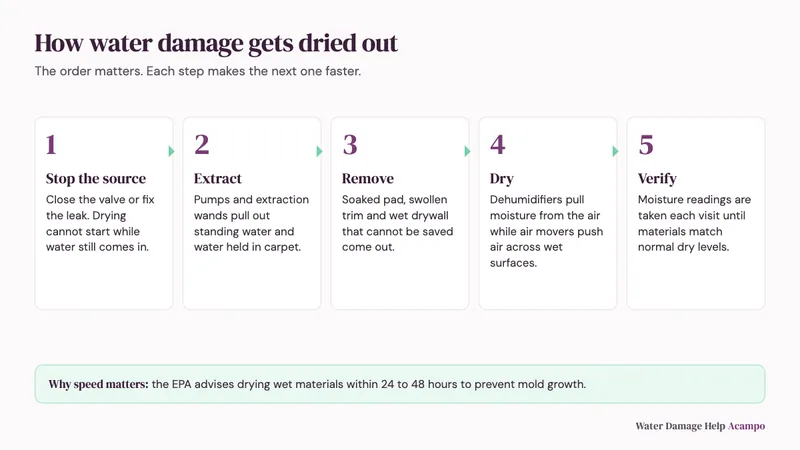
A floor can look dry on top and still hold moisture below. Laying new flooring too early traps that water. Request a written moisture log, and hold off the flooring installer until the numbers fall into the dry range.
For the equipment and how progress is tracked, see the structural drying page.
Will mold grow under flooring after a leak like this?
Yes, if things stay damp. The EPA's advice for preventing mold is drying wet areas and belongings inside 24 to 48 hours. A hidden leak is usually discovered after that window, which puts the back of carpet, pad and baseboard at real risk.
- Smell: a musty odor with no visible mold often means a damp cavity.
- Humidity: the EPA advises keeping indoor humidity below 60 percent, ideally 30 to 50 percent.
- Size: the EPA says that under about 10 square feet, most people can handle cleanup themselves. Hidden or larger mold calls for help.
- Never paint or caulk over mold, the EPA warns.
The California Department of Public Health notes there is no state licensing for mold assessors or remediators, so ask any company about its training and methods. Our mold guide goes further.
Does homeowners insurance cover a leak under the floor?
Frequently the resulting water damage is covered, though the pipe itself may not be, and policies vary. Plumbing-related water damage is typically covered, according to the NAIC. Triple-I lists accidental discharge or overflow from plumbing as a peril on standard forms. Wear and mold get different treatment.
- Harm done by the leak: floors, walls and the drying work are commonly the covered portion for an accidental loss.
- The pipe and the access cut: get your insurer to say in writing whether it pays for the line repair and the opening in the floor.
- Upkeep: Triple-I points out that damage traced to neglected maintenance is excluded.
- FAIR Plan: the California Department of Insurance says it covers fire and smoke and requires a separate policy for water damage.
In California an insurer has 15 calendar days to acknowledge a claim, and 40 calendar days from proof of claim to accept or deny it. Read the insurance claims guide for the steps.
How can I catch a hidden leak early?
Read the meter now and then and compare monthly bills. The EPA says leak detection and flow monitoring devices can alert you to irregular water use and reduce the damage a leak does. A meter check while the house is empty costs nothing and gives the earliest warning.
- Locate the house shutoff and confirm it turns.
- Photograph the meter before a trip and again on return.
- Compare bills from one month to the next for jumps you cannot explain.
- Feel the floors now and then for a warm patch.
- Check the usual suspects. The water heater leak page and the burst pipe page cover two of them.
The prevention guide adds more habits for any foundation type.
Sources: EPA WaterSense leak week; Wikipedia on San Joaquin County; NAIC homeowners page; Triple-I on covered disasters; CDI claims guide; CDI FAIR Plan statement; IICRC S500; CSLB contract guide; EPA mold and moisture guide; CDPH mold FAQ; 10 CCR 2695.7.