The short version
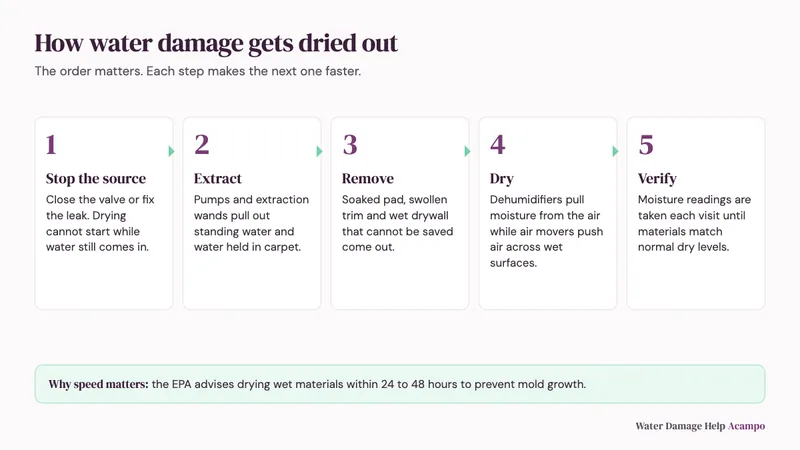
Emergency water damage restoration in Acampo begins with closing the nearest valve, staying away from wet wiring and gas appliances, and taking photos. Phone your insurer and then a restoration provider. The EPA says wet materials should be dry in 24 to 48 hours to head off mold.
When is water damage an emergency instead of a simple spill?
Emergency water damage restoration in Acampo is needed when water is still arriving, has touched wiring, or is soaking into drywall, insulation or a subfloor. Overnight is already too long to wait, since mold can start once materials stay damp. The EPA's target is a dry house inside 24 to 48 hours.
A single drip you spotted and mopped is routine. A supply line that split while the house was empty and ran for hours is not.
- A split pipe in an attic, an outside wall or the cabinet below a sink
- A water heater tank that gave out, or a washer or dishwasher hose that came loose
- A ceiling stain that grows, traced to the air handler, the roof or a bathroom above
- A toilet that overflows, or sewage rising through a floor drain or tub
- Runoff or river water coming indoors during a heavy winter storm
- More than one room wet, or water that has stood for a full day
What comes first when water is actively leaking?
Stop the water, make the room safe, and take photos before anything is moved. Then phone your insurer and a restoration provider. The California Department of Insurance's residential claims guide says to locate and stop leaks at their source without delay, and that fits a pipe, an appliance or a roof opening alike.
- Shut off the supply. Use the closest fixture valve, the water heater inlet or the house shutoff.
- Turn off power to wet rooms. Reach the breaker from dry ground only.
- Clear the room. Children and pets should stay out if the water is murky, deep or close to outlets.
- Record it. Take wide shots and close-ups of the source, the waterline and each damaged item.
- Notify the insurer. Triple-I says to reach your agent or company right away and take reasonable steps to prevent more damage.
- Reach a provider. Say where the water came from, which rooms are wet and how long it has been there.
- Raise the small stuff. Put rugs, books and electronics on dry surfaces, and set foil under furniture feet.
Resist the urge to rip out carpet or drywall before the photos exist. Triple-I suggests keeping damaged belongings until the adjuster has seen them and postponing major permanent repairs.
Where is the shutoff valve, and how do you close it?
Start with whichever valve is nearest. It could be the stop beneath a sink or toilet, the cold-water inlet at the heater, or the main valve at the point the line enters the house. When none of those will turn, the meter box near the road often has a valve, but it may need a special key.
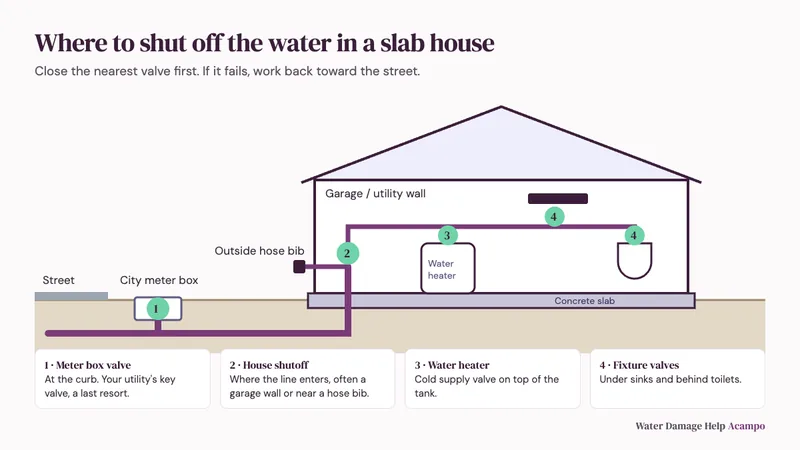
Find these on a calm day. Walk the outside walls, the garage and the meter box once, and remember that a heater in a garage or closet has its own inlet valve.
If your home is on a private well rather than a public line, the shutoff may be at the pressure tank or the pump, and a plumber can show you where. Do not force a frozen-tight valve with a pipe wrench. Phone a plumber and tell the restoration provider that water is still moving.
A meter that keeps spinning with every fixture closed points to a hidden leak. The slab leak guide lists the signs.
Can you stay inside when wiring and gas are involved?
Only when the water is shallow, clean and well away from outlets, the panel and gas appliances. Otherwise stay out of the wet area, switch power off from dry ground, and never touch electrical equipment while standing in water. If you are unsure, step outside and call for help.
- Extension cords, space heaters and wet vacs stay out of standing water.
- A gas furnace or water heater that sat in water needs an inspection before it runs again.
- Smell gas? Get out and call the gas utility from the yard or the street.
- Ready.gov warns that six inches of moving water can knock you off your feet and a foot can carry a car away, so stay off flooded roads.
On rural roads, check conditions before driving out. A dip in the road can fill fast during a storm.
How do you tell clean water from grey water or sewage?
The IICRC S500 standard puts water in three categories, and the category drives every decision about what gets dried and what gets thrown out. Flood water from rivers and outside surfaces falls in the worst one, so a storm leaves a very different job than a failed supply line.
| Category | Where it comes from | Usual handling |
|---|---|---|
| 1. Clean | A split pipe or a broken supply line | Often dried where it sits if work begins promptly. |
| 2. Grey | Washer or dishwasher discharge, or a toilet overflow without waste | Pad is typically removed and surfaces cleaned first. |
| 3. Contaminated | Sewage, rising river water, surface water from outdoors | Porous materials are usually discarded, and crews wear protection. |
Time matters here too. Clean water left standing for a day or two can be treated as grey.
When sewage or other contaminated water is the cause, the EPA recommends someone who has worked on contaminated-water damage before. The sewage backup guide explains why.
Plumber, insurer or restoration provider: which call comes first?
Whoever can stop the flow comes first, and that is a plumber when a valve will not close. After the water is off but the house is soaked, phone the insurer and a restoration provider back to back, since drying time started the moment the water arrived.
| What is happening | First call | Next |
|---|---|---|
| Still flowing, shutoff stuck | A plumber | Your insurer, then a restoration provider |
| Off now, floors and walls soaked | Your insurer | A provider for extraction and drying |
| Sewage inside | A plumber for the line | A provider that handles contaminated water |
| Outside water entering | Emergency services if you are in danger | Your flood insurer, then a provider |
Calls and requests here reach a local water damage restoration team that serves your area. Services, availability and pricing vary, so confirm each point directly with the team you reach.
What should you do if storm or river water is approaching?
Safety comes before belongings. Get everyone to higher ground, keep away from moving water, and stay out of a flooded house until officials clear it. Water that arrives from outside is Category 3, so cleanup follows a different path than a plumbing leak.
San Joaquin County is a low, flat basin with an exceptionally high water table, and it tends to flood in spring as Sierra snowmelt runs off. The Mokelumne River passes Lodi, with dams at Pardee and Camanche upstream built partly for flood control.
NOAA Research notes that roughly 30 to 50 percent of yearly precipitation in the west coast states arrives in a few atmospheric river events. One storm can therefore deliver a great deal at once, which is why the atmospheric river prep guide suggests acting before the rain.
When the water drops, photograph the damage and phone your insurer. FEMA states that most homeowners insurance excludes flooding, and the California Department of Insurance agrees. Next read flood cleanup and river flooding near Acampo.
What should happen between hour 24 and hour 72?
Day one is for stopping the source, extracting standing water and taking photos. Day two is for removing materials that cannot be saved and starting equipment. By day three, moisture readings should fall a little at every visit. If they do not, ask the provider why.
The CDC describes the same 24 to 48 hour window after a flood and says soaked carpet and upholstery that cannot be dried promptly should be removed.
Tell the provider if nothing is drying by the second day, because the equipment list may need to change. The water mitigation page and the water removal page explain how progress is measured.
Does a California homeowners policy cover sudden water damage?
Usually, if the cause is abrupt: a split pipe, a failed appliance hose or a roof leak. Floodwater from outside is a different matter. The California Department of Insurance says homeowners policies leave out flood damage but do cover other water damage. Read your own policy, because its wording controls.
Per NAIC, a leak from plumbing or the roof is typically covered, while ground water and rain runoff typically are not. Sewer backup, Triple-I notes, calls for an endorsement or its own policy.
Claims like this are common. The Insurance Information Institute counts about one in 60 insured homes a year, at an average cost of $15,400 over 2019 to 2023.
State regulations set the pace. An insurer must acknowledge your claim within 15 calendar days, and after proof of claim it has 40 calendar days to accept or deny it (10 CCR 2695.5 and 2695.7). The CDI consumer hotline, 1-800-927-4357, helps when a claim stalls. Details are in the insurance claims guide, and pricing context is in the cost guide.
Sources: EPA guidance on drying and mold; EPA on contaminated-water cleanup; IICRC S500; Ready.gov flood safety; CDC mold and health page; Insurance Information Institute claim statistics; Triple-I on covered perils; Triple-I on settling claims; NAIC consumer page; FEMA flood insurance FAQ; CDI residential claims guide; 10 CCR 2695.5; 10 CCR 2695.7; NOAA Research on atmospheric rivers; Wikipedia, San Joaquin County; Wikipedia, Mokelumne River.