The short version
Structural drying in Acampo pairs air movers with dehumidifiers and checks progress with a moisture meter. The EPA sets a 24 to 48 hour starting target and a ceiling of 60 percent indoor humidity. A reading, never the calendar, tells you the building is dry.
How does structural drying actually work?
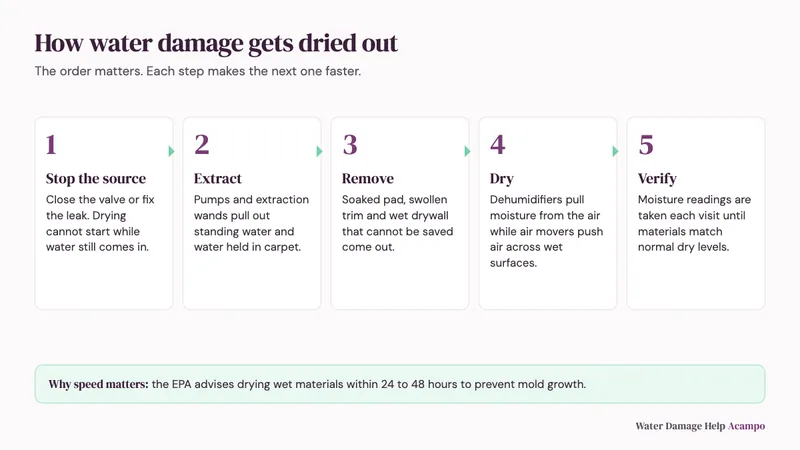
Structural drying pulls trapped water out of a building's walls, floors and framing after a leak or flood, following a plan. Air movers speed evaporation from wet surfaces, dehumidifiers collect the vapor that results, and a meter tracks progress. The target is the building material itself, not merely the air around it.
It is one stage of water mitigation. Extraction comes ahead of it, as described on the water removal page, because machines cope poorly with a floor that is still under water.
This site is the local water damage restoration line and information resource for Acampo and nearby San Joaquin County communities. Equipment, methods and scope differ from one team to the next, so confirm what each will do at your address.
What equipment dries a water-damaged house?
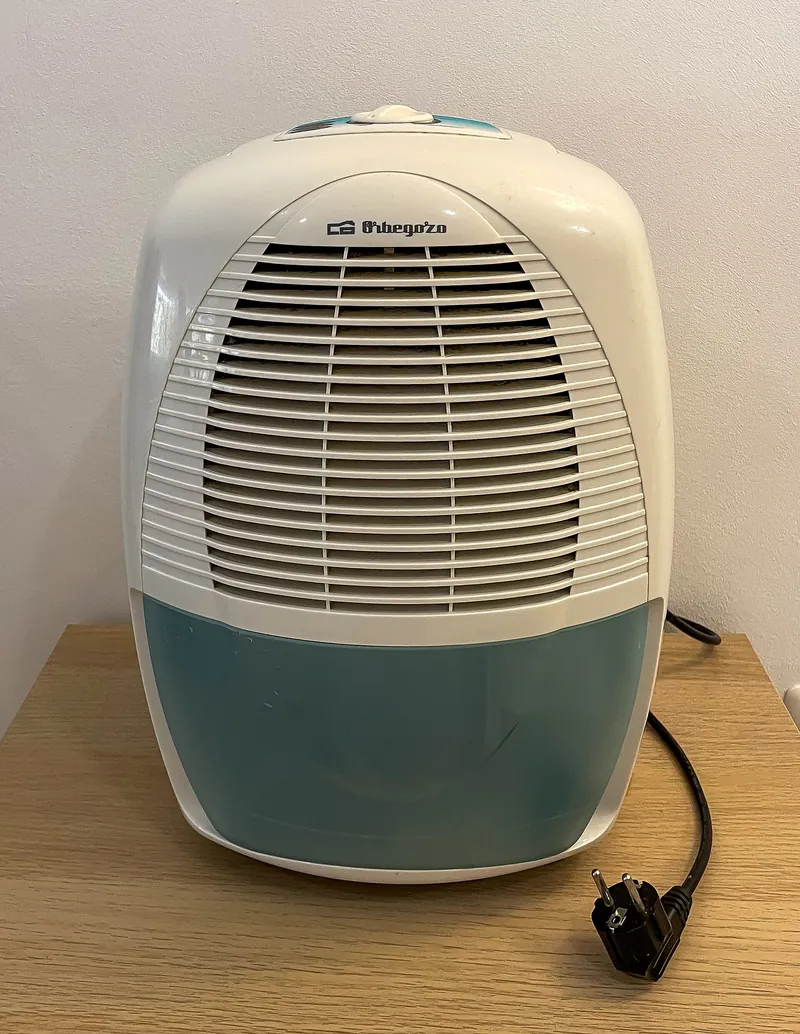
Most of the work falls to three machine types: air movers, dehumidifiers and air scrubbers. They operate as a system, each with its own task. Each provider picks its own brands and unit counts, so ask what is going into your rooms and the reason.
| Tool | Its job | Question to ask |
|---|---|---|
| Air mover | Sweeps air over wet surfaces to speed evaporation | Where is each one pointed? |
| Dehumidifier | Pulls released vapor out of the air before it lands on cool walls | Is the space closed so it can work? |
| Air scrubber | Filters dust and particles, mostly when walls are open | Does this job need one? |
| Moisture meter | Reads dampness in drywall, wood and subfloor at marked points | Will I see readings every visit? |
| Thermal camera | Shows cool damp patches so a meter can confirm them | Are images backed by meter numbers? |
An ordinary box fan shifts air but takes no water out of the building, and fans with no dehumidifier can push damp air into dry rooms. The water damage glossary defines terms you will meet on a work authorization.

How many days does structural drying take?
Often a few days, though readings set the end date, not the calendar. Framing, subfloor and concrete are dense and give up their water slowly. EPA guidance aims for wet areas and items to be dry in 24 to 48 hours, but a provider can only estimate once the first readings are in.
That two-day target is about starting fast and drying surfaces. Deeper material can take longer. Several factors move the timeline:
- Delay: the hours materials sat wet before anyone started.
- Category: dirty water means more material is torn out rather than dried.
- What got wet: gypsum board and carpet release water faster than oak, plaster or concrete.
- Concealed moisture: a soaked wall plate or insulation behind a sound-looking wall stalls progress.
- Obstructions: built-in cabinets and tile can hold moisture against the wall behind them.
Any day count a provider promises up front is only a guess. A job declared finished without readings to show for it has proven nothing.
Does the Central Valley climate change how drying works?
It can, because drying moves water from materials into the air and then out of the air. Wikipedia describes Lodi's climate as hot and dry in summer and cool and wet in winter, often with dense ground fog. Damp winter air outside works against drying, while dry summer air gives it more room.
Either way, drying normally happens in a sealed-up building with machines running. Ask whether the thermostat should stay on and where to set it. Opening windows during a foggy week may add water instead of removing it.
The EPA recommends keeping indoor relative humidity below 60 percent, with 30 to 50 percent as the ideal band, and says air conditioners or dehumidifiers can help. Ask which humidity reading the provider expects in the drying room, and compare it to that range.
How do you dry a concrete slab or a wet subfloor?
Concrete dries slowly from the top, and its surface can read dry while the slab underneath is still damp. A wood subfloor over a crawl space may dry from both sides if the space below can be reached. Either way, flooring usually has to come up first so dry air touches the base.
This site has no record of how homes near Acampo are built, so match the advice to your own house. If your floor sits on a slab, water spreads across it and wicks into the foot of the walls. If your house has a crawl space, ask whether the provider will look underneath.
- Carpet and pad: expect the pad to be removed. The carpet itself is either lifted and dried or thrown out, as covered in wet carpet drying.
- Hardwood and engineered boards: they swell and cup, and only some flatten again. Read water damaged floor repair.
- Tile on a slab: the tile survives, yet water may linger in the grout, the setting bed and the concrete.
- Vinyl and laminate: water often slips under the planks, so they usually come up to let the base dry.
If the water came from a pipe beneath the floor, that leak is a plumbing problem first. Read about a slab leak before drying anything, since a running leak keeps the floor wet.
How do you know structural drying is finished?
Drying is done when the readings in each material match a dry reference, normally an untouched area of the same material in your own home. Judge by numbers, not by the machines. A log with dated readings at marked spots is the proof, and a missing log is a warning.
On each visit, a solid log lists room, material, reading and date, along with air conditions and equipment in place. When the figures stop dropping, the provider should go looking for concealed water.
A dry-feeling room or departing machines are not proof. Ask which reading closed out the job, and request the log. The guide to choosing a restoration company helps with questions about billing.
What are the first moves for a room that is soaked?
Begin by stopping the water, making the space safe and recording the damage. Machines are pointless while a leak still runs or wiring is at risk. These first moves cost nothing, they strengthen an insurance claim and they hand the provider a clean starting point.
- Shut off the supply. For a plumbing leak, close the main water valve. For an overflowing condensate drain, turn the air conditioner off. More is on the emergency water damage page.
- Check the electricity. With water near outlets, appliances or the panel, switch off that circuit only if the breaker is reachable from dry ground. If not, phone an electrician.
- Take photos and video before moving things, which is Triple-I's advice for claims.
- Clear the floor: rugs, books, boxes and furniture feet.
- Leave the cooling on unless the unit or its ducts got wet.
- Ask for a connection to a restoration provider and raise equipment, readings and the log.
Waiting to see what happens is the costly choice. For a flooded home, the CDC calls for a complete and fast dry-out, inside 24 to 48 hours.
Can you stay home while the equipment runs?
Expect noise, extra warmth and heavy power use for several days. Fans and dehumidifiers run around the clock, and dehumidifiers add heat to a closed room. Many households sleep elsewhere, particularly when the drying zone includes a bedroom or the water was contaminated.
- Noise: ask where each unit will sit and whether any can stay clear of bedrooms.
- Electricity: several machines can trip a breaker, so ask about circuits first.
- Kids and pets: keep both clear of cords, moving air and opened wall cavities. See cleanup safety for kids and pets.
- Leave the machines alone. A unit that gets moved can leave a wet area untouched.
The CDC notes that mold can cause stuffy nose, coughing and eye irritation, that people with asthma or mold allergy may react severely, and that immune-compromised people can develop lung infections.
Is renting a dehumidifier enough to dry a house?
Only for a small, clean spill on a hard floor, caught fast. A rented unit cannot reach water inside walls or beneath flooring, and a unit working alone leaves surfaces damp. The EPA says a humidity meter costs $10 to $50 and shows whether a room is trending dry.
For anything beyond that, ask a provider to measure first. Renting can still make sense for a minor spill, and the rental versus professional page compares the two routes.
- Rental units do not tell you what is happening inside a wall.
- Running one in an open room lets it chase outdoor air rather than the damp surface.
- A meter reading, not the water tank filling, shows real progress.
If your rented unit fills quickly, that only shows that moisture is leaving the air, not that the framing behind the wall has dried.
Does insurance pay for structural drying in California?
Often, when the cause was a covered source such as a sudden plumbing failure. The NAIC describes plumbing and roof-leak damage as typically covered, with ground water and rain runoff damage falling outside most policies. Your own policy wording governs, so read it or call your agent.
Triple-I tells policyholders to take reasonable steps to protect the property and keep receipts. Drying counts as one of those steps, and permanent repairs wait for the adjuster. The California Department of Insurance adds that drying and dehumidifying can reduce the chance that mold follows water damage.
Flood is treated separately. Triple-I lists it as excluded from standard homeowners and renters policies, and FEMA states that most homeowners insurance leaves flood losses uncovered. See water damage insurance claims for the process.
What signs show that drying stopped too early?
If a smell comes back, a spot stays damp or a reading rises again, the drying was not finished. The clearest warning is a musty odor that returns once the machines are gone. Warped floors, blistering paint and soft baseboards point the same direction.
- A sour or musty smell that returns on rainy or humid days.
- Soft, cool or clammy baseboards, cabinet bases or wallboard.
- Floors that buckle, cup or lift over a base that was still wet.
- Dark flecks on a wall or ceiling, covered in the mold guide.
- Indoor humidity that stays above the 60 percent line the EPA sets.
Spotting any of these is a reason to ask the provider for fresh readings before walls close. The EPA advises against painting or caulking over mold. After walls test dry, water damage repair picks up the story.
Unsure whether your ZIP code is covered? Check the service areas or send a request.
Sources: EPA, mold and moisture guide; EPA, mold cleanup; CDC, mold and health; Wikipedia, Lodi; NAIC, homeowners insurance; Triple-I, settling claims; Triple-I, disaster coverage; FEMA, no flood insurance FAQ; CDI, Residential Property Claims Guide.