The short version
Atmospheric river preparation for Acampo homes means clearing gutters and drains, finding your water shutoff, filming every room and checking flood cover early, since a flood policy takes 30 days to start. After the storm, dry wet areas in 24 to 48 hours and call a provider early.
What is an atmospheric river, and why does it matter near Acampo?
An atmospheric river is a narrow stream of humid air that moves tropical moisture toward the West Coast and releases it as heavy rain and mountain snow. For homes near Acampo, it means a few storms can deliver much of a winter's water, and the ground, drains and roofs have to cope with all of it at once.
NOAA Research describes atmospheric rivers as long, concentrated regions in the atmosphere that move moist air from the tropics to higher latitudes. Its estimate is that a few of these events typically account for roughly 30 to 50 percent of a year's precipitation along the western states.
That is a regional figure, not a number for one town, but it explains why water problems tend to arrive in clusters. Acampo Water Damage Help is a local information resource. This page covers the water side of a big storm.
What did the 2022 to 2023 storm series do to the Central Valley?
NOAA's satellite service reports nine atmospheric rivers in a row from late December 2022 into January 2023. More than 32 trillion gallons of rain fell across California, and flooding reached the Central Valley along with outages and mudslides. San Joaquin County sits in that valley, so the same pattern can repeat here.
The same NOAA piece cites at least 21 deaths and more than 1,400 rescues. Meanwhile the California Nevada River Forecast Center counts over a dozen atmospheric rivers across December 2022 to March 2023, and puts the cost of that stretch's flooding disasters at $3.5 billion (December 26, 2022 to March 19, 2023).
Outages matter too. A wet house with no heat, no fans and no dehumidifier stays wet.

Why does the Acampo area stay wet after the rain stops?
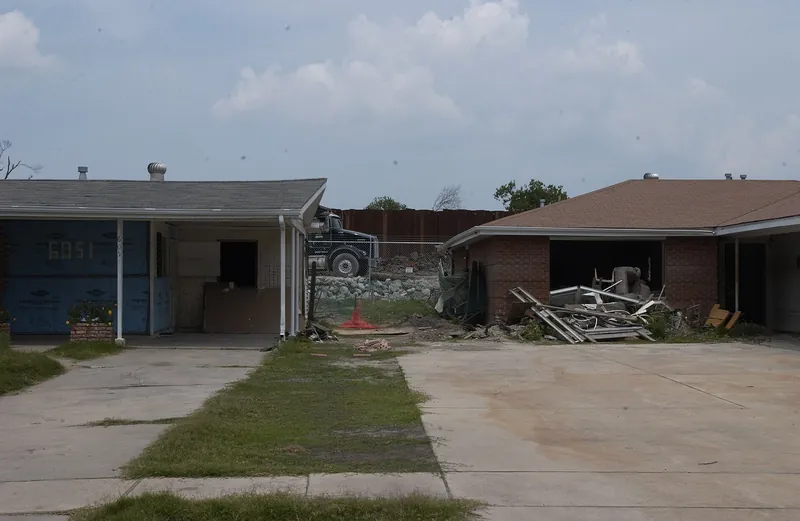
Acampo sits in a very flat part of the Central Valley, and the county around it has an exceptionally high water table. Rain that cannot soak in or run off has nowhere to go, so it pools in yards, driveways and low spots near the house for longer than you would expect.
Wikipedia's county article describes San Joaquin County as a very low, flat basin with an exceptionally high water table, and says it tends to flood in spring when Sierra snowmelt runs off. The same article puts Lodi, the nearest city, in a climate of cool, wet winters, often with dense ground fog. Fog and cold air slow drying indoors as well.
The Mokelumne River runs past Lodi, with Pardee Dam several miles upstream. Camanche Dam was built below it in 1963, and flood control for downstream communities was its primary purpose. Farther west, the Sacramento-San Joaquin Delta has about 1,100 miles of levees, and Wikipedia counts over 160 levee failures there since 1900.
See the creek and river flooding guide for how that water reaches homes.
By which routes does storm water reach the inside of a house?
Storm water enters a house from above through the roof, from the side through doors and walls, from below through the floor, and back up through drains. Each route leaves different damage, falls into a different water category and is treated differently by insurers, so it helps to know which one you have.
| Route in | First signs | Water category | Policy usually involved |
|---|---|---|---|
| Through the roof or a broken window | Ceiling stains, dripping light fixtures, wet attic insulation | Often Category 1 or 2, worse if it sits | Homeowners, if wind or another covered cause made the opening |
| Overland flow under a door or through a wall | Wet baseboards, a water line on the lower wall | Category 3 under IICRC S500 | Flood policy |
| Rising ground water through the floor | Damp flooring, musty smell, lifting boards | Category 3 if it comes from outside | Flood policy |
| Sewer or drain backup | Water from the lowest tub, shower or floor drain | Category 3 | Separate endorsement or product |
Under IICRC S500, outside flood water and sewage both count as Category 3, meaning grossly contaminated. That label changes how the work is done. Read the flood cleanup page for the overland case and sewage backup cleanup for drains.
How do I get the house ready ahead of the storm?
Spend the warning days opening water paths, lifting valuables and recording the rooms. Ready.gov suggests clearing drains and gutters, moving valuables upstairs or onto shelves, and storing papers in a waterproof container with password-protected copies online. Most of that costs very little.
- Clear the gutters and downspouts. Leaves and debris send roof water down the wall instead of away from it.
- Point downspouts away from the foundation. Water that drops beside the house tends to find a way in.
- Find the main water shutoff. If a pipe or fixture fails during the storm, you want to stop the supply fast. The prevention guide shows where shutoffs usually sit.
- Video every room. Open closets and cupboards, and keep the file somewhere other than the house. The photo checklist lists what to capture.
- Raise what you can. Lift electronics, paper files and boxes off the floor, and away from outside doors.
- Check your coverage. Read the declarations page and ask your agent about flood and sewer backup cover before the storm, not during it.
If your home has a crawl space or an attached garage, look at how water drains around them. If your home is on a septic system, ask a septic professional how a saturated yard affects it.
What should I do while the storm is hitting?
Stay out of moving water, keep away from wet electrical equipment and deal with active leaks only if it is safe. Ready.gov points out that just six inches of moving water can take a person off their feet, and a foot can float a car away. Do not drive around barricades.
If water is coming through the ceiling, move people and belongings out from under it and put a bucket below the lowest point. Our ceiling water damage page explains how to relieve a bulging ceiling without making it worse. Switch off power to a wet room only if you can reach the breaker without standing in water.
Ready.gov says to follow emergency alerts and evacuate when told to. A house can be dried or rebuilt. Keep notes on what you see and when, since they help later with the insurer.
What do I do once the water has gone down?
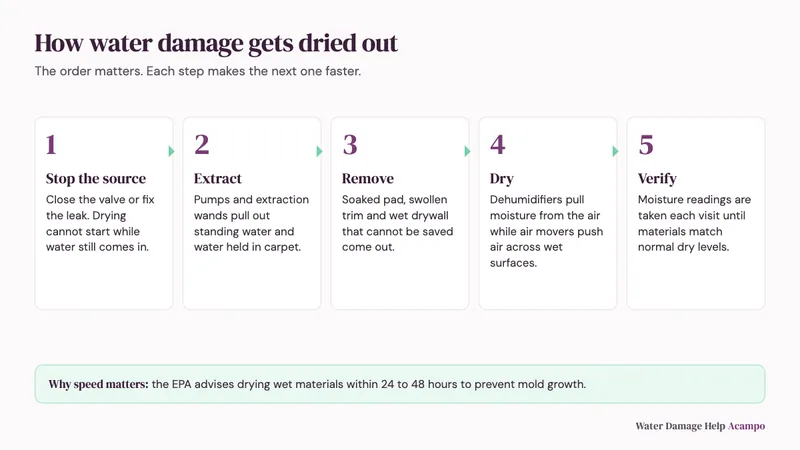
Check that the house is safe, photograph everything, stop any water you can stop, then start moving wet material out and air through the rooms. The CDC's advice after a flood is to get the home clean and dry quickly, inside 24 to 48 hours, and to take out soaked carpet and upholstery that cannot be dried at once.
Wear boots, gloves and protective clothing and bring a second person. Ready.gov says anyone with asthma, a lung condition or a weakened immune system should keep out of buildings that have indoor leaks or visible mold. Children should not help clean.
Our kids and pets cleanup safety page goes through the household side.
Indoor humidity is worth tracking too. The EPA wants it under 60 percent, with 30 to 50 percent as the ideal, and a low-cost humidity meter will show where a room stands.
Does insurance cover atmospheric river water damage?
The answer turns on the water's path. Per the California Department of Insurance, a homeowners policy leaves out flood but can pay for other water damage, for instance rain entering through a roof or window opening that wind or another listed cause created. Flood is sold separately.
On its flood page, the department notes that a new flood policy starts 30 days after it is bought, except for certain borrowers whose lender requires it. A climate working group report from the department put National Flood Insurance Program policies at under 5 percent of California homes in September 2019.
NAIC lists ground water and rain runoff as typically not covered by homeowners insurance, and Triple-I says sewer backup is covered neither by a typical homeowners policy nor by flood insurance. The flood versus homeowners insurance page and the claims guide go through the details.
When should I call a restoration provider?
Reach out once the house is safe to enter, or sooner if water is inside walls, pooled in rooms or rising from a drain. A regional storm sends many households to the phone at once, and early contact gives you a better chance of being heard before the EPA's 24 to 48 hour drying window closes.
Restoration teams differ on what they take on and when they can arrive. Ask each one directly about contaminated water, temporary roof covering, drying and contents, and ask for moisture readings and photos. Terms are set by the provider, not by this site.
If water is still entering, start with the emergency water damage page. A hole overhead is covered under roof leaks and storm water damage, and the guide index lists the rest.
Sources: NOAA Research explainer on atmospheric rivers; NOAA NESDIS report on the 2023 storms; CNRFC winter 2022 to 2023 storm summary; Ready.gov, Floods; CDI property claims guide; CDI flood insurance page; CDI climate working group report; NAIC, homeowners insurance; Triple-I, which disasters are covered; IICRC water categories; CDC mold page; EPA mold guide; Wikipedia, San Joaquin County; Wikipedia, Lodi; Wikipedia, Mokelumne River; Wikipedia, Sacramento-San Joaquin River Delta.